SSSTC PQ2 Brings KIOXIA QLC Flash to Industrial M.2 SSDs
SSSTC's PQ2 pairs KIOXIA BiCS FLASH gen 8 QLC with PCIe Gen4 in M.2 2280 and 2230 sizes up to 2TB. Pricing and availability are still unannounced.
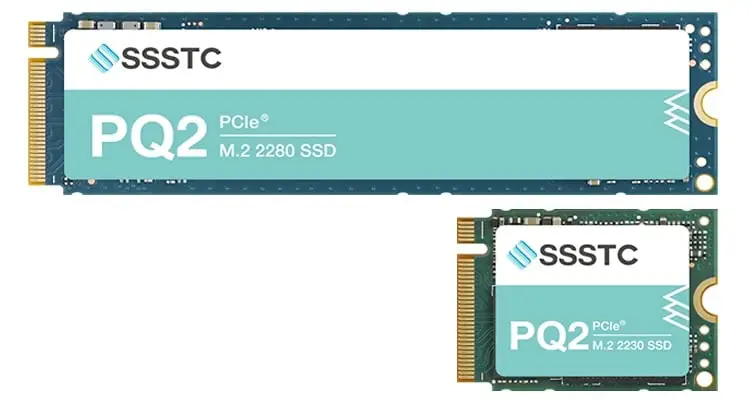
SSSTC, the KIOXIA subsidiary, has put its first industrial-grade QLC drive on the table with the PQ2 series. The headline number is up to 7,000MB/s sequential reads over PCIe Gen4 x4, but the more interesting question for anyone specifying embedded hardware is whether QLC flash belongs in boot and read-heavy roles that have traditionally gone to TLC or pSLC parts. SSSTC is betting it does, and the spec sheet is built around that argument.
What's actually on the board
The PQ2 uses KIOXIA's 4-bit-per-cell QLC NAND, built on BiCS FLASH generation 8 with CMOS directly Bonded to Array (CBA) construction. SSSTC says CBA improves density, performance and power efficiency. Those are the claims to hold loosely until independent testing arrives, but the density point explains why QLC exists at all: storing four bits per cell is cheaper per gigabyte than three, at the cost of endurance and write behaviour.
The drives are DRAM-less and rely on Host Memory Buffer (HMB), so the controller borrows a slice of system RAM for the mapping tables an onboard DRAM chip would normally hold. That keeps the board small and the bill of materials lean, and it's standard practice in compact client and embedded designs. The trade-off is that random-access behaviour depends on the host actually providing HMB and on how much memory it gives up, which matters more on a constrained device than in a laptop with 32GB installed.
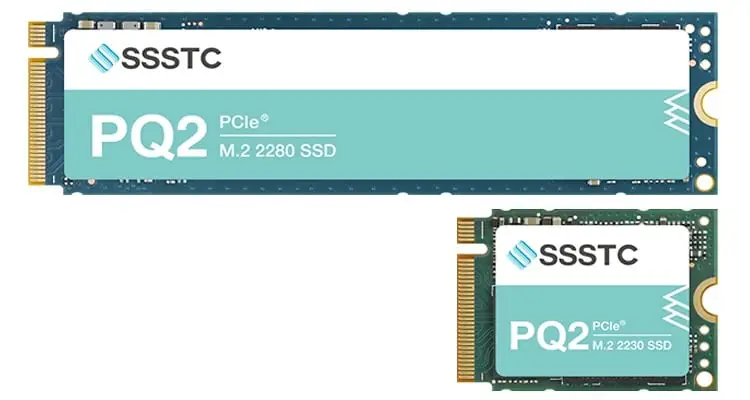
Physically, the two form factors split the range. The M.2 2280 measures 80mm by 22mm and weighs up to 6g. The M.2 2230 is 30mm long, weighs up to 3g, and is aimed at compact devices and embedded boards where a 2280 simply won't fit. Both come in 512GB, 1TB and 2TB capacities, which gives integrators a consistent capacity ladder across two board footprints.
Reading the performance figures
SSSTC rates the PQ2 at up to 7,000MB/s sequential read, up to 6,200MB/s sequential write, and up to 1,000K IOPS for both 4KiB random reads and random writes. It supports NVMe 2.0d. Treat every one of those as a ceiling. SSSTC doesn't break the numbers out by capacity, doesn't name the test platform, and says results depend on host and workload. A 2TB part and a 512GB part can behave differently, and a Gen4 host will see different results from one that negotiates down.
The ratings line up exactly with the EG7 Series, the client QLC drive from parent KIOXIA. That's a useful clue about the PQ2's lineage: it appears to be the EG7 silicon and design repackaged for industrial buyers, with the same flash generation, the same DRAM-less approach and the same three capacities. For a procurement team, that means the industrial variant's headline performance should track the client product's behaviour, but the industrial qualification around it is a separate question.
Sequential write at 6,200MB/s is the figure I'd scrutinise most. QLC drives usually rely on an SLC cache to post high burst write speeds, and sustained writes after that cache fills are where QLC parts typically diverge from their datasheet numbers. SSSTC's material doesn't describe the cache design, so anyone planning write-heavy use should ask for sustained-write data under their own workload before assuming the peak applies.
Endurance, workloads and where it fits
SSSTC rates endurance above 1 drive write per day (DWPD) over three years and aims the series squarely at read-heavy work. Put in concrete terms, one DWPD on a 1TB model means writing roughly 1TB every day for three years. That's a generous allowance for a boot drive, a point-of-sale terminal or a thin client, and a tight one for logging or database duty. SSSTC doesn't publish total bytes written for each capacity, so the DWPD figure is the only endurance number to plan against.
The named use cases follow that logic. For AI PCs, the drive's job is mostly loading locally stored models and reading application data, which is a good match for QLC's strengths. Point-of-sale terminals, thin clients, networking devices and embedded boot storage all tend to read far more than they write. The same QLC generation also appears in KIOXIA's data centre LD4 Series, where KIOXIA targets read-heavy storage too, so the design philosophy is consistent across segments even though the form factors and endurance envelopes differ.
Environmental ratings and security
For industrial buyers, the temperature numbers matter as much as the speed. The PQ2 operates from 0C to 85C and stores from -40C to 85C. SSSTC lists every model at that standard grade, with no wide-temperature variant announced. If your deployment sits outside a 0C floor, such as unheated enclosures or outdoor kiosks, that's a gap to raise before design-in rather than after.
SSSTC quotes MTBF above 3 million hours and mentions vibration and shock resistance, though it doesn't publish numeric ratings for either. Ask for those figures in writing. The security feature set is more concrete: AES 256-bit hardware encryption, with TCG Opal or TCG Pyrite available as optional features. Data protection covers LDPC error correction, end-to-end data protection and firmware-based power-loss protection. Power-loss protection in firmware is the detail to verify in your own tests, because it's the feature that decides whether an embedded device recovers cleanly after an abrupt power cut.
What to check before specifying it
Pricing and availability haven't been announced, so the practical work starts now. Teams evaluating the PQ2 should ask for sustained-write results on the exact capacity they plan to buy, confirmation of HMB behaviour with their target platforms, vibration and shock figures, and the optional TCG configuration they need. If you're building boot storage for devices with mixed host platforms, test on each one rather than assuming the Gen4 rating carries across.
My read is that the PQ2 is less about raw speed and more about whether QLC has earned a place in industrial and edge storage. The answer depends on write volume, temperature range and how much you trust the cache behaviour. Once SSSTC publishes pricing and sustained-performance data, that's the point where this moves from an interesting datasheet to a shortlist candidate. The SSSTC PQ2 Series product page is where those details will surface first.


