AIStor Memory Goes GA as Datadog BYOC Logs Land on Your Own Storage
MinIO's AIStor Memory is now generally available, and Datadog has certified AIStor for on-prem BYOC, so log data can stay in your own cluster.
Two announcements from MinIO at SC26 matter more together than apart. AIStor Memory, the agent memory layer that started as a technology preview, is now generally available. And Datadog has certified AIStor as an on-premises foundation for its Bring Your Own Cloud model, which means logs can sit in your own cluster while Datadog's query tools still reach them. If you run AI workloads and an observability stack on the same infrastructure, both changes are worth a look before your next planning cycle.
Both are available now. The timing also marks two years since AIStor launched in November 2024, and MinIO is using the anniversary to pitch its store as the place where AI data and operational data converge.
What GA means for agent memory
AIStor Memory holds long-term memory, persistent workspaces, and secrets for AI agents, all on infrastructure you control. The idea is that what an agent learns becomes governed organisational knowledge, and only authorised agents can reuse it across sessions. MinIO says that reuse improves response quality and cuts latency and token costs. It hasn't published figures for either claim, so treat them as vendor direction rather than measured results until you test them in your own environment.
The GA release keeps the three components from the preview in one system. That consolidation is the practical change: you're managing memory, state, and credentials in one place instead of stitching them together. MinIO hasn't said whether AIStor Memory carries separate licensing. Its availability statement covers AIStor as a whole, including AIStor Tables and AIStor Memory, so ask your account team to confirm how it's priced before you assume it's bundled.
Tables and memory on the same store
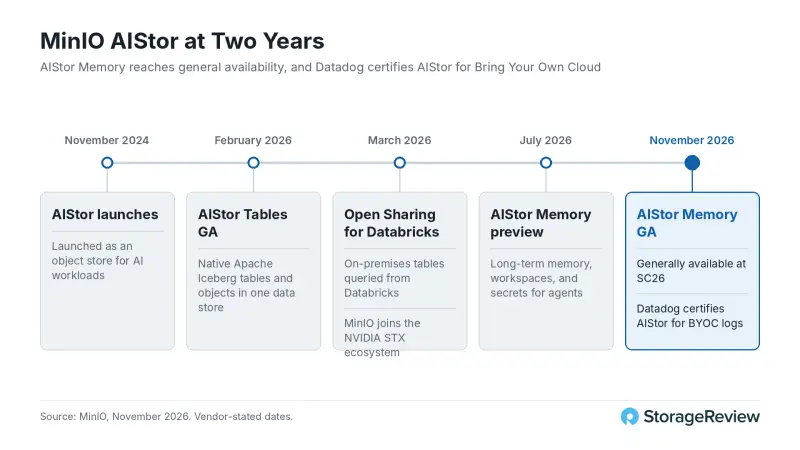
AIStor Tables has been generally available since February and puts native Apache Iceberg tables and objects in the same data store. MinIO describes the result as a lakehouse where Iceberg tables index logs, telemetry, financial transactions, machine-generated events, and vector embeddings alongside documents, audio, and video. A common catalog makes that data discoverable to analytics tools and to authorised agents. AIStor Memory runs on the same store, so the data agents read and the knowledge they generate stay in one place.
Here's the thing: that architecture only pays off if your teams are already pushing data toward open table formats. Since launch, AIStor has added S3 Express API support, S3 over RDMA, and ExaPOD, a reference architecture developed with Intel, Solidigm, and Supermicro for exabyte-scale deployments. Its Open Sharing for Databricks, introduced in March, lets Databricks query on-premises tables without duplicate cloud datasets or replication pipelines. Databricks named MinIO its 2026 ISV Storage Partner of the Year. Stephen Orban, SVP of product ecosystem and partnerships at Databricks, said teams can query on-premises Iceberg and Delta tables through OpenSharing and govern them in Unity Catalog.
How Datadog BYOC splits the work
Datadog BYOC lets you ingest, retain, and search logs inside your own environment while still querying and correlating them with metrics and traces in Datadog. With AIStor as the storage layer, logs are written to your AIStor cluster, the BYOC engine runs in that environment, and only query results travel back to Datadog. Datadog breaks the setup into three parts: Observability Pipelines workers that collect logs, BYOC indexers that write searchable files to an AIStor bucket, and searchers that connect to Datadog over an outbound TLS connection. Indexing and search run inside your Kubernetes cluster.
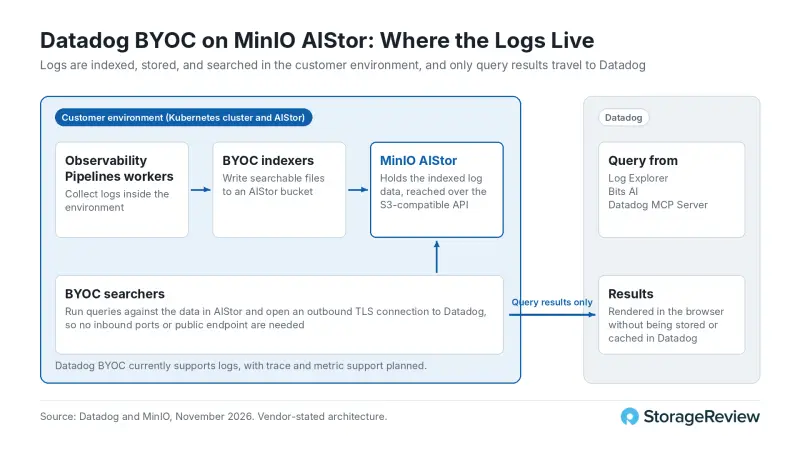
The pitch is aimed at regulated sectors such as financial services, healthcare, and telecom, and at teams that sample traffic, drop fields, or shorten retention to keep log costs down. Keeping every log on AIStor also changes the shape of an investigation. A query that reaches back months doesn't have to wait on a restore from a cold tier. Michael Whetten, SVP of Product at Datadog, said AIStor lets on-premises customers "keep every log locally without compromising on visibility." Built-in key management covers encryption requirements, and AIStor Tables lets the same system hold Iceberg data beside the logs.
That said, there are gaps you'll want to chase down. Datadog says BYOC currently supports logs, with trace and metric support still to come. MinIO cites API-call and Model Context Protocol telemetry as a driver of log growth, and that traffic is covered only to the extent it arrives as logs. Neither company has defined what the certification tested, and neither has published sizing guidance, ingest rates, or query performance for the combination. On the pricing side, MinIO says AIStor is priced on usable capacity with no per-operation or egress charges. The store also exposes native Prometheus metrics and OpenTelemetry tracing so you can monitor AIStor itself.
Flash and NVIDIA hardware tie-ins
MinIO joined the NVIDIA STX ecosystem in March and announced further work in May to support the NVIDIA Vera BlueField-4 STX storage architecture. On the flash side, Larry Hart, senior director of solutions marketing for Micron's Core Data Center Business Unit, said testing of AIStor with Micron 6600 ION SSDs showed greater performance with lower demands on power and compute. No figures from that testing were published, so the claim is directional for now. MemKV, which MinIO positions for inference context, remains a separate product from AIStor Memory. Don't conflate the two when you scope a design.
What to check before you test
My read is that the GA of AIStor Memory is the easier decision, because it's a consolidation of pieces you may already be evaluating. The Datadog certification is more interesting for teams that have been pricing out log retention or considering a move off a hosted observability bill. Start with a non-production cluster. Confirm the licensing model for AIStor Memory, map which log sources would actually reach Datadog as logs, and ask for the test conditions behind the certification before you commit to ingest volumes. The benchmark gaps are real, and the first numbers you collect from your own workload will matter more than any vendor claim.


