DDN Opens EXAScaler 7 Lustre to Standard Servers, Starting With the AI2200
DDN's EXAScaler 7 will run as software on qualified industry-standard servers, beginning with the AI2200, with a limited beta planned for early 2027.
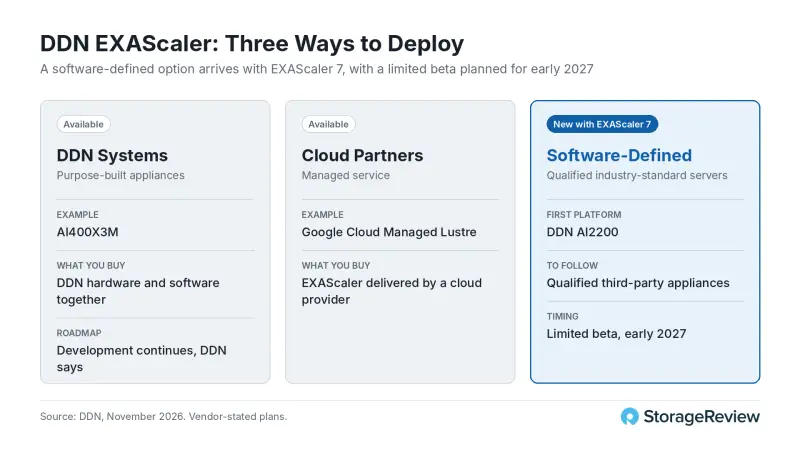
DDN is about to stop treating EXAScaler as something you buy only inside its own hardware. The upcoming EXAScaler 7 release adds a software-defined option, so customers can install the Lustre-based parallel file system on qualified industry-standard servers. The first of those is DDN's own AI2200, and qualified third-party appliances are supposed to follow. For anyone who has specified AI storage around a DDN box, that changes the buying conversation.
Until now, EXAScaler has been available only in DDN's purpose-built appliances or through cloud partners. My read is that this is the bigger shift here, more than any single feature in the release. A limited beta is planned for early 2027, and DDN is adding multi-tenancy, data protection and performance features to EXAScaler in the first half of 2027.
Why a Parallel File System Matters for AI and HPC
DDN describes EXAScaler as open Lustre with AI I/O optimization, automated deployment and enterprise support. The reason a parallel file system exists is that a single storage server becomes the bottleneck very quickly. A parallel design spreads reads across many storage servers at once, which is what AI and HPC jobs need when they generate large numbers of small files, metadata-heavy reads and frequent checkpoints.
EXAScaler is the file system inside appliances such as the AI400X3M, which DDN launched at ISC 2026. DDN says it will keep building purpose-built systems for customers who want a complete, single-vendor solution. The software-defined option is an addition to that lineup, not a replacement for it.
What the Software-Defined Option Changes
With EXAScaler 7, the same software runs on what DDN calls verified hardware from a growing set of suppliers, beginning with the AI2200 server. DDN pitches the option at hyperscalers and cloud providers that already run storage infrastructure, and at AI platform teams that want to choose their own hardware to match their requirements.
Here's the thing: the announcement leaves a lot of the practical detail open. DDN has not named third-party hardware vendors, published minimum hardware requirements, or said how the software will be licensed. If you're planning procurement for 2027, those three gaps matter more than the feature list. Licensing in particular determines whether running EXAScaler on your own servers is cheaper or simply different.
Omer Asad, Chief Product Officer at DDN, tied the move to the rest of the portfolio: "By making EXAScaler available as software, we're extending that flexibility across our portfolio." The same logic applies to DDN Infinia, which gained multi-tenancy and POSIX support in version 2.4 and is already available in a software-defined format. EXAScaler also remains available through cloud partners, including Google Cloud Managed Lustre.
Tenant Controls, Recovery and Audit
EXAScaler 7 will add multi-tenancy REST APIs that apply per-tenant quality-of-service limits and fair sharing. In practice, that lets several research or product teams share one file system without one team's training run starving the others. File Restore recovers accidentally deleted files, and an audit log supports investigations into who did what and when.
On performance, DDN lists intelligent hybrid I/O for higher throughput and IOPS. The company has not published performance figures for any of these features and says validated data will follow. Until those numbers appear, treat the throughput claims as direction rather than sizing input.
One Dataset, Two Workloads
DDN's example for the software-defined option is a site running HPC simulation and AI training against the same data without copying it between environments. Copying is expensive in both capacity and time, and it creates versioning headaches, so keeping one data set serving both workloads is an attractive goal.
In life sciences, researchers can train AI surrogate models on the outputs of molecular dynamics simulations to predict protein behaviour without rerunning every simulation. That's the kind of workflow where a shared parallel file system pays off, because the simulation output and the training input are the same files. DDN has not given a general availability date beyond the early 2027 beta, and it says all of its dates are targets that may change.
AMPHIX HyperPOD Reports 98.8 Percent GPU Utilization on Infinia
DDN also published results from the first DDN Enterprise AI HyperPOD installed at AMPHIX, the RAVEL and Strata Expanse deployment model that named RT-One as its first commercial customer. HyperPOD is a packaged system built on Supermicro servers with NVIDIA accelerated computing, and its storage is DDN Infinia. That means the result applies to DDN's other data platform and was not run on EXAScaler.
In a 24-hour training test at the AMPHIX Center of Excellence in California, RAVEL recorded 98.8 percent GPU utilization, with zero thermal throttling or GPU errors and 37C of thermal headroom at peak load.
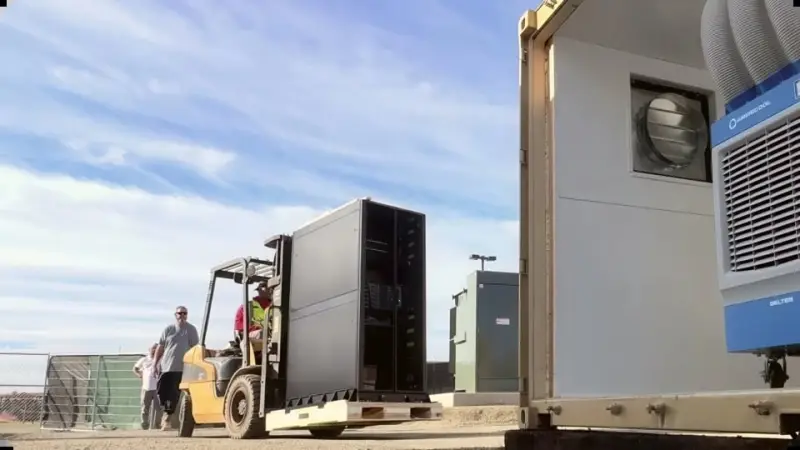
DDN told us the system had eight NVIDIA RTX PRO 6000 GPUs and 500TB of Infinia running on Supermicro hardware. The job trained a large language model based on the GPT-2 architecture from 70TB of raw training data. All of it was read from and written back to storage over S3 across the network. GPUs held 95 percent utilization or higher for 98 percent of the run, and hardware telemetry was sampled once per second.
Those are good numbers for a single-node-class system, but they're AMPHIX's own test and haven't been independently audited. Eight GPUs typically fit in one server, so the run shows a small HyperPOD keeping its accelerators busy for a day while streaming training data over S3. It says little about behaviour at cluster scale. DDN has not published training throughput, the inference results RAVEL also collected, or the server and network configuration. AMPHIX is offering the system for customer proofs of concept at the California site, and Strata Expanse and RAVEL plan to connect more than 100 sites.
What to watch next: the qualified-hardware list, the licensing model and the first performance figures for EXAScaler 7's tenancy and hybrid I/O features. If you run Lustre today, the beta is the point to test whether your existing deployment tooling and support model carry over to software-only installs. If you're buying AI storage in 2027, ask for those three answers in writing before you commit to a server platform.


