Hammerspace Ships Its First Hardware With the OFP Flash Tray, Rated at 390GB/s
Hammerspace now sells its software as a complete system. Its 1U OFP flash tray is rated at 390GB/s writes and 9.83PB raw, shipping in H1 2027.
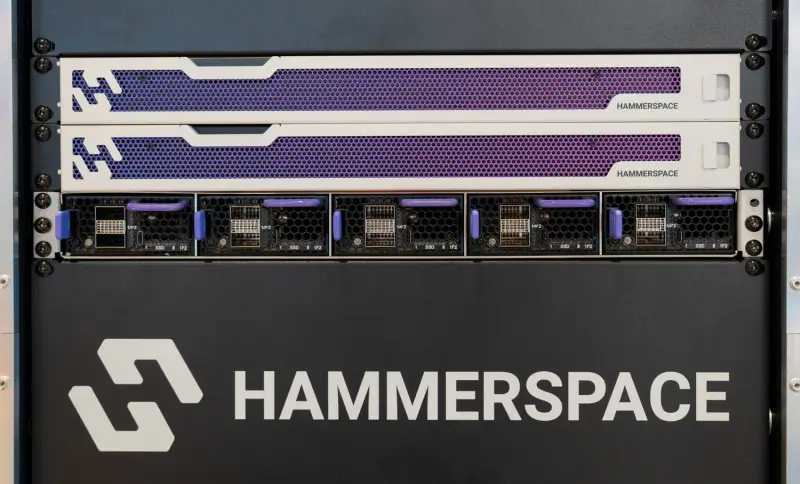
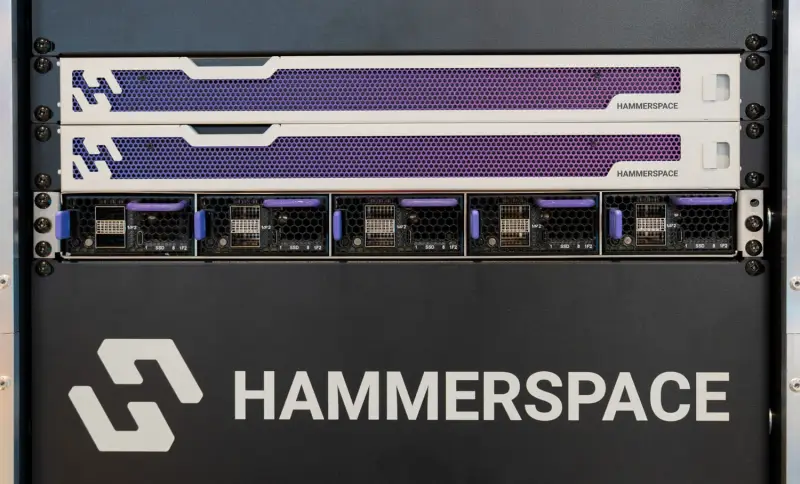
Hammerspace has spent years as a software company, selling a parallel global file system that runs on hardware customers already own. That's changing. The company has rebranded its software as the Hammerspace Data System and, for the first time, will sell it as a complete package with storage hardware attached. The new centrepiece is the Hammerspace Open Flash Platform (OFP), a 1U tray holding up to five DPU-based flash nodes. There's no x86 storage server inside. Hammerspace rates the tray at 390GB/s of writes without mirroring, and up to 9.83PB raw. OFP is available to quote now and ships in the first half of 2027.
From Software Platform to Full System
The underlying product hasn't changed much. Hammerspace separates metadata from the data path and presents existing NAS, object and cloud storage as one namespace over pNFS, NFS, SMB and S3. Linux clients use the NFSv4.2 client that ships in standard distributions, so there's no proprietary agent to deploy. The company says it engineered the Flex Files layout for the NFS specification.
Hammerspace now describes the software as an extension of that platform, organised around five capabilities: data unification, intelligence, orchestration, acceleration and storage. Intelligence and storage are the new parts. The commercial shift is what matters most for infrastructure teams. The whole stack, including software, metadata nodes and storage, can now be bought from Hammerspace and supported by the company.
The metadata nodes, which Hammerspace calls Anvils, are 1U x86 servers in Standard and Large M-Series configurations. Each has two 100GbE data ports and runs as a high-availability pair at every site. That pair hosts the control plane that manages the namespace and executes placement policies. Software-only deployment on customer hardware continues. So do Hammerspace Ready Nodes from Dell, Supermicro and Hitachi Vantara, and marketplace images on AWS, Azure, Google Cloud and Oracle Cloud.
The system option answers a pattern Hammerspace says it keeps seeing in sales. The software wins the technical evaluation, then the customer buys an integrated product from another vendor because the purchase is simpler. Software is licensed as a subscription priced by capacity under management. Hammerspace hardware typically enters when a new GPU cluster needs fast storage, while existing data stays on NetApp, PowerScale or object systems that the namespace takes over in place.
Clusters join into one global file system. Metadata replicates continuously between sites, with about one second of lag across long distances. Data moves only when a policy or an access request calls for it. Job schedulers can trigger movement through the API and native connectors. Hammerspace's example is life sciences customers who ingest instrument data over SMB, process it over pNFS and serve it over S3 from the same system.
Inside the Open Flash Platform
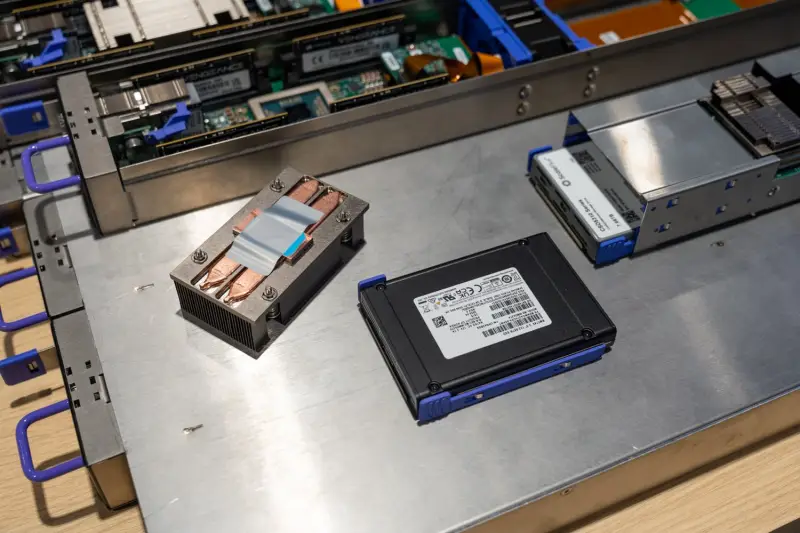
Each OFP sled is a complete storage node, one-fifth of a rack unit wide. It carries eight U.2 or U.3 NVMe SSDs in two removable four-drive packs, two 400GbE QSFP-DD ports, and a 64-core Arm DPU where an x86 motherboard would normally sit. That DPU is the Xsight Labs E1. Xsight builds it on TSMC's 5nm process, with 64 Arm Neoverse N2 cores, two 400G MACs, PCIe Gen5 and a typical power figure of 70W. It runs standard Linux, and each sled appears to the Hammerspace file system as an NFS server.
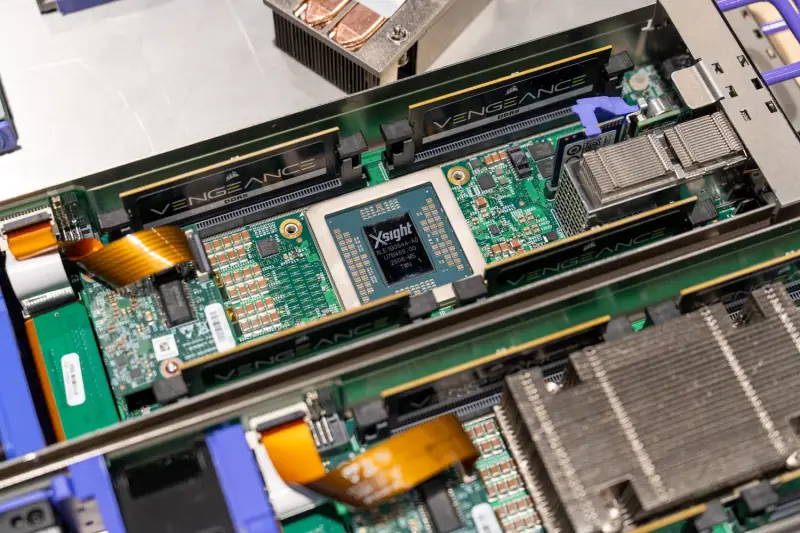
A tray holds one to five sleds. Fully loaded, that's up to 40 drives, 320 Arm cores and ten 400GbE ports per rack unit. Hammerspace lists a maximum of 360W per sled and 1,800W per tray, fed by dual 2,160W Titanium power supplies. Sleds and drive packs are tool-less to service, and management runs over IPMI and Redfish.
Here's the part infrastructure teams should check first. The tray is 106.64cm deep and needs a 1,200mm rack, which rules out shallower enterprise cabinets. Hammerspace also lists air cooling with a 40°C maximum inlet temperature at sea level. Hammerspace puts drive density at 3.3 times that of a typical 2U, 24-bay NVMe server, which works out to 160 SSDs in 4U against 48.
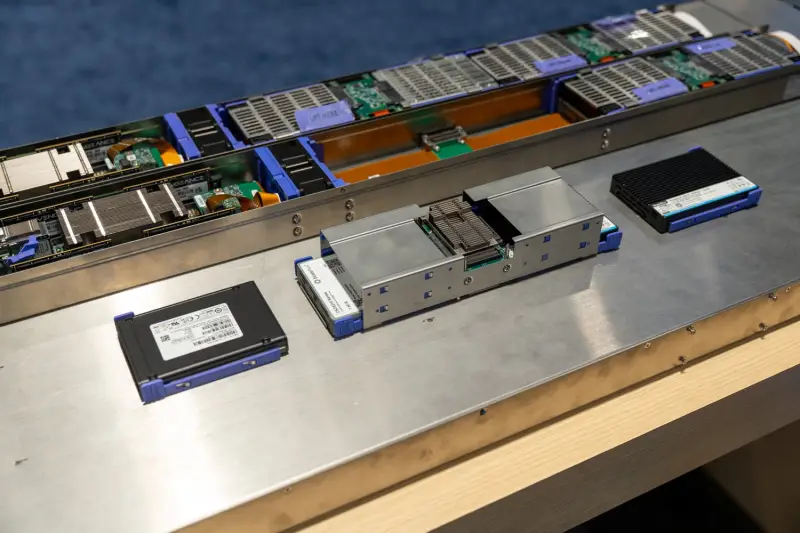
Capacity depends on drive choice. With eight 245.76TB QLC SSDs, the largest Hammerspace lists, and drives of that class such as the KIOXIA LC9, a sled holds 1.97PB raw and a full tray holds 9.83PB. At the tray's 1,800W maximum, that's roughly 183W per raw petabyte. Sleds accept TLC or QLC drives on PCIe Gen5 or earlier. Hammerspace positions TLC for performance and QLC for capacity. A 42U rack filled with trays would hold about 413PB and draw up to 75.6kW.
The design traces back to the Open Flash Platform initiative Hammerspace started in 2025, with Xsight Labs and Los Alamos National Laboratory among the named participants. In October 2025, Hammerspace said production systems would arrive in early 2026. The schedule has now slipped by about a year. Hammerspace chose U.2 and U.3 drives because they ship in volume today, but it says the sled was laid out with denser form factors in mind. The company and Xsight have described a path to an exabyte per rack, more than twice what a full 42U of the largest current drives would hold.
Performance Claims and Test Conditions
Hammerspace rates a five-sled tray at 390GB/s of write throughput without mirroring, and 15 million 4K random read IOPS. The stated conditions are NFSv4.2 with pNFS over TCP, on a 400GbE fabric, using enterprise Gen5 TLC SSDs. Reads are rated at up to 80GB/s per sled, or 400GB/s per tray. That's about 40GB/s through each of a sled's two 400GbE ports. Once protocol overhead is counted, the network ports are effectively the ceiling on read throughput.
Protection is handled by mirroring, set per file or directory through policy and changeable online. Writes drop to 195GB/s per tray with two-way mirroring and 130GB/s with three-way. Two-way mirroring also halves usable capacity, to about 4.9PB on a fully populated QLC tray. For data that can be regenerated, such as KV cache, Hammerspace suggests running without mirrors.
Hammerspace claims two to five times the per-rack-unit performance of an unnamed nearest competitor. It hasn't published latency, client counts, or IO500 and MLPerf Storage results for OFP. Until independent numbers exist, treat the headline throughput and IOPS as vendor-rated figures under the conditions above, not as guarantees for your workload.
| Specification | Hammerspace Open Flash Platform |
|---|---|
| Architecture | DPU-based flash storage nodes, no x86 storage server |
| Sled | 8 x U.2/U.3 NVMe SSDs in two 4-drive packs; 64-core Arm DPU (Xsight Labs E1); 2 x 400GbE QSFP-DD |
| 1U tray | 1 to 5 sleds; up to 40 SSDs; up to 320 Arm cores; up to 10 x 400GbE |
| Maximum raw capacity | 1.97PB per sled; 9.83PB per tray (245.76TB QLC SSDs) |
| Write throughput, no mirror | 78GB/s per sled; 390GB/s per tray |
| Write throughput, 2-way / 3-way mirror | 195GB/s / 130GB/s per tray |
| Read throughput | 80GB/s per sled; 400GB/s per tray |
| 4K random read | 3 million IOPS per sled; 15 million IOPS per tray |
| Maximum power | 360W per sled; 1,800W per tray |
| Form factor | 1U tray, 106.64cm deep; requires a 1,200mm rack |
| Management | IPMI, Redfish |
| Availability | Quoting now; shipping in the first half of 2027 |
Tier 0, Tier 1 and the KV Cache Role
Hammerspace places OFP at Tier 1. Behind it sits a Tier 0 made of the NVMe already inside GPU servers. The system exports that NVMe over NFS and pools it into a shared, cluster-wide tier, with no client or agent needed on the compute nodes. Data written there is mirrored across the cluster for protection and moved to other tiers by policy. Hammerspace says a common pattern is to write training checkpoints locally and let the system move older ones to object storage.
In the layout Hammerspace describes, NVMe inside GPU servers maps to the tier NVIDIA labels G3, and a TLC-filled OFP tray in each rack maps to G4. Early adopters, according to Hammerspace, are hyperscalers that put one or two trays at the top of each GPU rack. They value rack and performance density over power savings. Hammerspace says prototype work on the sled began about two years ago.
Hammerspace quotes 4.4 times the sequential bandwidth and 56 percent lower latency for Tier 0 against external shared storage. It hasn't published the test configuration behind those figures.
The KV cache role builds on the same tier. The logic is straightforward. An inference server that can reload a conversation's computed context from shared storage doesn't have to recompute those tokens on the GPU. Hammerspace doesn't act as the cache manager. It presents the pooled Tier 0 NVMe, with OFP behind it, as POSIX storage for the inference software's own cache manager to use.
Data Intelligence: Catalogue, Scanning and Policy
The new intelligence layer starts with a catalogue that indexes file and object metadata across every storage system in the namespace, without moving any data. A second level, called DeepScan, opens files to look for personal, financial and protected health information. It runs on demand or on a schedule, and its findings become searchable tags. Queries can be written in natural language through an LLM of the customer's choice.
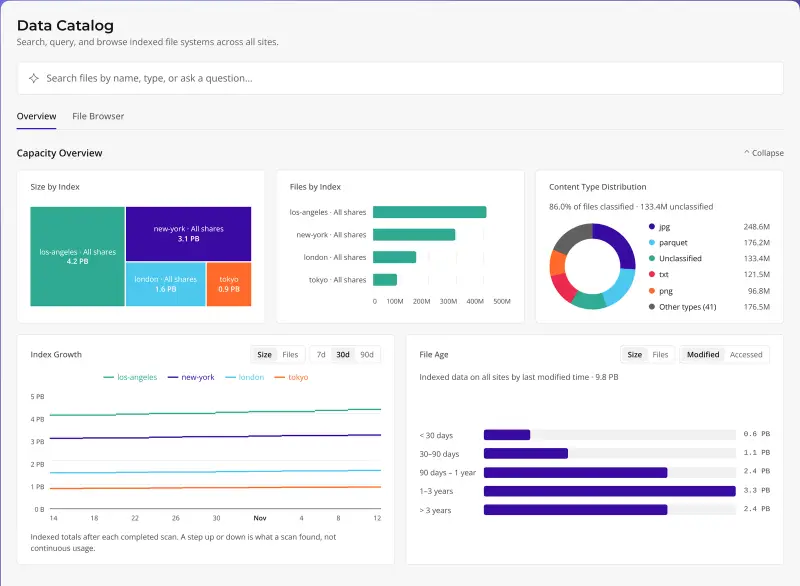
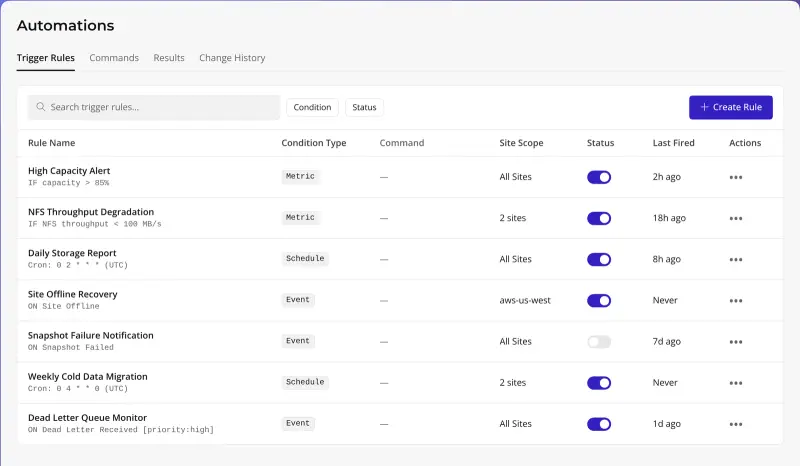
Results feed the existing policy engine, which Hammerspace calls objectives. An administrator could, for example, find every file tagged as training-ready or restricted to one country, then attach a placement rule to that set. Objectives are declarative rules attached to a share, volume, directory or file. Examples include moving data untouched for 30 days, or keeping three copies across three sites. New automations trigger them from conditions such as capacity thresholds, schedules and events, with a preview step before changes are approved. Tags inherit down the directory tree and follow files between storage systems and clouds.
The software covers file and object stores from any vendor. It doesn't manage structured data.
Early Customers and What to Watch
The reference customer at launch is kaiko, a clinical AI company with offices in Amsterdam and Zurich that trains models on imaging and pathology data. Kaiko runs Hammerspace across Microsoft Azure and the Nebul and Nebius GPU clouds as one namespace. It uses the NVMe in its GPU nodes as Tier 0 for training, and checkpoints land on Azure Blob Storage by policy. Hammerspace says all of kaiko's ML engineering workflows on those three clusters have moved to the system. That case study doesn't involve OFP hardware.
Hammerspace also said kaiko adopted the system while growing from about 128 GPUs to more than 1,000 on Nebius. Its existing all-flash NAS in the Nebul cloud was brought into the namespace in place. A separate, unnamed hyperscale AI research lab replaced Amazon FSx for Lustre with a 30PB Hammerspace cluster in AWS. Lustre had been its largest source of support tickets over the prior year. That lab is now extending the namespace to an on-premises data centre, and Hammerspace cites about three times faster large-file operations there.
OFP joins a growing set of designs that put a DPU where the storage server's processor used to be. NVIDIA's BlueField-4 STX reference architecture, introduced at GTC, is one example. Hammerspace's difference is that it pairs the hardware with a file system that also runs without it. Hammerspace is demonstrating the hardware at SC26 and hasn't published pricing.
My read: the buying decision will hinge less on the 390GB/s headline than on the physical details. Check rack depth, cooling inlet limits and drive choice against your floor plan. Then look at the capacity cost of mirroring, since a two-way mirror cuts usable space in half. Those numbers will tell you more about OFP fitting your environment than any single benchmark will, and independent results will matter once they appear. Shipping in the first half of 2027 gives teams time to test before committing.


