SC26 Roundup: Flat TOP500, Aurora's IO500 Lead, and Job-Aware Storage QoS
SC26 brought the thinnest TOP500 turnover on record, a PCIe Gen6 flash server now shipping, and VAST storage QoS tied to Slurm, PBS Pro and LSF jobs.
Most of the headline launches at SC26 in Chicago's McCormick Place have been about GPUs. The more useful news for storage and infrastructure teams sits one layer down. Flash is moving closer to the accelerators, KV cache is becoming a storage workload, and the schedulers that place jobs are starting to talk to the file system. The TOP500 barely moved this year, which makes the rest of the show easier to read.
TOP500: An Unchanged Top 10 and the Lowest Turnover on Record
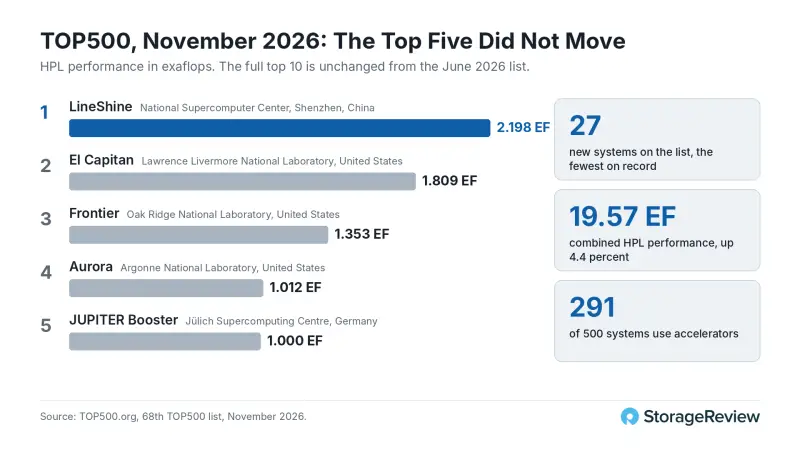
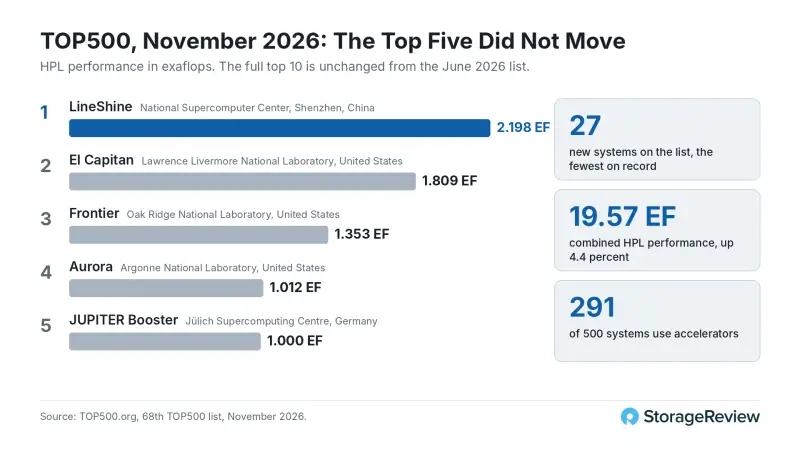
The 68th TOP500 list kept the top 10 identical to June. China's LineShine at the National Supercomputer Center in Shenzhen holds first place at 2.198 exaflops on HPL. El Capitan follows at 1.809 exaflops, Frontier at 1.353, Aurora at 1.012, and JUPITER Booster at 1.000. Only 27 systems are new, or 5.4 percent of the list, and the organizers describe that as the lowest turnover in the list's history.
The aggregate picture is more interesting than the podium. Combined performance rose 4.4 percent to 19.57 exaflops, and the entry point at No. 500 climbed to 2.857 petaflops. Some 291 systems now use accelerators. That tells you the installed base is getting denser while the number of brand-new machines shrinks, which is what you'd expect when large sites are running long refresh cycles.
The top newcomer is HANGANG at KISTI in South Korea, an HPE Cray EX254n built on NVIDIA GH200 Superchips. It debuts at No. 12 with 342.6 petaflops. HPE's Lux system at Oak Ridge debuted two places lower, at No. 14. LineShine also leads the HPCG benchmark at 22.00 petaflops, and El Capitan leads the mixed-precision HPL-MxP test at 16.7 exaflops. The Green500 top 10 is unchanged too, with France's KAIROS first at 73.28 gigaflops per watt on a BullSequana XH3000 with GH200 Superchips.
TOP500 November 2026 List
IO500: Aurora Posts a Score About 13 Times the Runner-Up
The IO500 story is where the storage crowd should spend its time. Argonne's Aurora tops the production list with a new DAOS submission that scored 46,192.01 from 4,096 client nodes. It reported 12,296 GiB/s of bandwidth and 173.5 million metadata operations per second. The runner-up, LRZ's SuperMUC-NG Phase 2, scored 3,470.22, so Aurora's result is roughly 13 times higher.
KISTI's HANGANG, the HPE Cray system that debuted in the TOP500, lands third on Lustre at 1,155.89. Of the 52 production entries, eight are new. They include IBM's Blue Vela on Storage Scale System 6000, Georgia Tech's Nexus on VAST, and two DDN EXAScaler systems at Purdue. The research list has no new entries in its top five, and Pengcheng Cloudbrain-II still leads it at 210,255.
Much of the new activity among 10-node submissions came from vendor labs rather than big sites. Hammerspace entered a Tier 0 configuration over pNFS at No. 29, scoring 688.01 with 449.86 GiB/s of bandwidth. Dell's Lightning File System scored 568.66 at No. 37, and DDN's AI400X3M with EXAScaler scored 317.47 at No. 53. IBM added several Storage Scale System 6000 results. Korea's Telecommunications Technology Association placed a 10-node DAOS system from Gluesys at No. 19, with a score of 1,242.79.
My read: a 10-node entry is a sales tool, not a sizing guide. Use these results to see which stacks are being tuned seriously, then benchmark against your own I/O profile before you buy anything.
IO500 SC26 Production List

Flash Moves Toward the GPUs: PCIe Gen6 Arrives in Storage Servers
Several vendors pitched the same idea this year: inference clusters need a flash tier that sits near the GPUs, with capacity storage behind it. Supermicro says its first PCIe Gen6 all-flash storage servers are now shipping. The chassis is a 2U Petascale system on AMD EPYC 9006 SP7 processors, with up to 32 E3.S NVMe SSDs. With 122.88TB drives, that comes to 3.93PB in one box, and the system has room for up to four x16 network cards. Supermicro claims up to 100 percent more sequential read bandwidth than PCIe Gen5, but it did not publish the test configuration behind that figure. More models are due as AMD releases SP8 processors.
Supermicro lists Hammerspace, IBM, MinIO, Nutanix, Scality, VAST Data, VDURA, and WEKA as software-defined storage partners validated on the platform. IBM said Storage Scale runs on the new server for inference pipelines that include KV cache. AIC and MSI are also showing PCIe Gen6 E3.S designs on the same processor family, so three vendors now have Gen6 storage servers on EPYC 9006. Supermicro is the only one that says its system is shipping today.
AIC is covering each tier of the same inference stack. The F2026 is a 2U PCIe Gen5 JBOF with 26 dual-port NVMe bays, dual canisters, and support for up to four DPUs, serving flash over NVMe-over-Fabrics. MangoBoost builds its Mango KESAR-E enclosure on that platform. The HA2026-HC puts two active-active AMD EPYC nodes behind the same 26 bays. The SB103-JP is a 1U server with up to 16 E3.S PCIe Gen6 NVMe bays and a single EPYC 9006 processor. For capacity, the SB407-ID is a 4U server with 60 hot-swap 3.5-inch bays, six rear PCIe Gen5 NVMe bays, and dual Intel Xeon 6 processors. The J4078-02-04X is a 4U 78-bay 24Gb/s SAS JBOD. AIC gave no availability or pricing for any of them.
AIC
Phison and TRUSTA: Controllers, Computational Drives and KV Cache Tiers
Phison previewed three technologies. Its X3 (PS5303) enterprise SSD controller targets up to 28GB/s of sequential throughput and 6.8 million IOPS over PCIe Gen6 x4 with NVMe 2.3. The company says that is close to twice what Gen5 drives deliver. Its PS7161 is the first PCIe 6.0 redriver on the PCI-SIG Integrators List. A computational storage design places an NPU rated at 36,800 DMIPS and 64GB of memory inside the drive, with support for PyTorch, vLLM, OpenVINO, and llama.cpp. Phison estimates it can cut data transfers by 10 to 100 times for suitable workloads. The third design, Mixed Media, puts high-endurance pSLC and high-capacity QLC flash behind a single 16-channel controller. That removes the need for dedicated cache drives. Phison notes that losing one of 24 such drives removes about 4 percent of the cache, where a design with dedicated cache drives would lose 25 percent. The company gave no product names, capacities, or dates for the computational or mixed-media drives.
Phison also launched the Phison AI Data Platform with generative BI, an on-premises system sold in four-GPU or eight-GPU configurations and available now. It combines the company's aiDAPTIV cache memory with Wren AI, which turns natural-language questions into SQL-backed dashboards, and it uses TrueNAS as the backup and restore target. In Phison's lab testing with the Wren AI agent, aiDAPTIV supported twice the concurrent sessions on the same GPUs, with 3.7 times faster time to first token. Those are Phison's numbers, and the test setup was not detailed.
TRUSTA, the enterprise storage brand of ADATA, is at SC for the first time. Its upgraded AI Scaler Toolkit integrates vLLM and spreads KV cache across three tiers: GPU memory for active requests, DRAM as a fast cache, and TRUSTA PCIe Gen5 SSDs as a large tier that persists across restarts. Long contexts reload from flash, and conversations resume after a reboot without being recomputed. The toolkit supports llama.cpp and the Strata inference engine. TRUSTA's Strata build uses Intel AMX to speed prompt prefill by up to 25 percent over upstream Strata v0.2.11. That figure comes from TRUSTA's testing on a Xeon w5-3535X with one RTX 6000 Ada GPU. The gain was about 11 percent on a single 8K-token input and about 25 percent in multi-turn conversations, and TRUSTA found no gain for inputs above 12K tokens. The drives are the TD7P51 ECO and T7P5, PCIe Gen5 SSDs up to 15.36TB in U.2, E1.S, and E3.S, rated at up to 3 DWPD with Flexible Data Placement and power draw under 20W. TRUSTA published no time-to-first-token or throughput numbers for the offload itself, which is a gap worth noting if you're comparing it against session-density claims from other KV cache products.
VAST Puts Job Identity Into the Storage Path
The item I'd flag for anyone running shared HPC or AI clusters is VAST Data's Job-Level Quality of Service for the VAST AI Operating System. It carries a job's identity from the workload manager into the storage layer. The VAST NFS client tags I/O requests with configurable job identifiers from Slurm, PBS Pro, or LSF. Administrators can then set separate bandwidth and IOPS policies per job, including several jobs running on one node. Policies can change while jobs run, with no restart, application change, or remount. An optional open-source VNFS Collector reports per-job bandwidth, IOPS, and errors to Prometheus, Grafana, or the VAST DataBase.
The problem this addresses is familiar to anyone who has run a shared file system: one I/O-heavy job starves its neighbours. Today the usual fixes are coarse, such as queue-level limits, separate file systems, or simply asking users to behave. Per-job controls that don't require stopping the offending workload are a different kind of tool. VAST plans general availability with VAST AI OS 5.6 by February 2027, and the feature needs VAST NFS 4.8 or later. The company is demonstrating it at SC26, says the design also works with Kubernetes and other orchestrators, and has not published performance figures. Plan for the version dependency before you assume it fits your current release train.
Object Storage Gets Smaller Entry Points and Analytics in Place
Hitachi Vantara lowered the entry point for VSP One Object to a four-node starting configuration with a simplified deployment process. The company says continued small-object tuning delivers up to 5.5 times faster data access for AI, analytics, and S3 workloads. The object store can now run analytical queries directly against Iceberg, Parquet, JSON, and CSV data. Hitachi Vantara puts that at up to 5 times faster with 80 percent fewer CPUs. It gave no baseline or test configuration for any of these three figures. The company also expanded multisite replication and regional capabilities.
On the software side, Hitachi iQ Studio adds filesystem and NFS knowledge sources for retrieval-augmented generation, a Model Gateway for governed access to local and external models, governed Model Context Protocol connectivity, and ServiceNow support. Hitachi Vantara is demonstrating iQ Studio agents and analytics running against VSP One Object data. That places it alongside Dell ObjectScale and MinIO AIStor in the on-premises object storage market aimed at AI data. Node specifications, capacities, pricing, and availability dates were not part of the announcement.
Hitachi Vantara VSP One
Google Cloud's SC26 summary puts Managed Lustre at up to 10TB/s of read throughput. The service offers GPUDirect Storage over RDMA and an 80PB Dynamic Tier that mirrors to Cloud Storage. Google gave no configuration behind the throughput number. On compute, A5X bare metal instances on NVIDIA Vera Rubin NVL72 are now available alongside the A4 and A4X Blackwell instances, and Google's Batch service supports single-host TPU slices. For teams that already run EXAScaler or Lustre on premises, Managed Lustre is one of the cloud routes to that software stack.
Marvell Sells the Argument, Not a Product
Marvell announced no new products at SC26. Its booth is built around one claim: AI clusters are now held back by memory and connectivity as much as by compute. The demonstrations include a Photonic Fabric memory module, Structera CXL add-in cards for memory expansion and compression, and Alaska A active electrical cables at 800G and 1.6T. Teralynx 10 and T100 switch silicon, OCTEON DPU storage designs, and Bravera SSD controllers are on display too. Marvell gave no performance, reach, or power figures and did not name its partners.
Server Vendors Fill In the Rest of the Rack
The server lineup is where the GPU-adjacent hardware shows up. MSI's EPYC 9006 servers are the new part of its booth. The 2U dual-socket CX272-S6082 has 32 DDR5-8000 RDIMM slots and 32 front E3.S 1T bays on PCIe 6.0 x4. The 1U single-socket CX172-S4081 has 16 of each. For multi-node work, the ORv3 CD182-S6091-X2 packs two direct liquid-cooled dual-socket nodes into 1OU, with 32 DDR5-8000 slots and four E1.S PCIe 6.0 bays per node. The air-cooled CD281-S4091-X2 puts two single-socket nodes in 2OU with eight E3.S 1T bays each. MSI lists CPU TDPs of up to 600W on the Open Compute platforms. Its Xeon 6 versions stay on PCIe 5.0 U.2 bays, and it lists Instinct MI350P configurations without model details or dates.
ASUS says it will ramp volume shipments of NVIDIA Vera Rubin NVL72 racks in the fourth quarter. Its AI POD XA VR721-E3 holds 72 Rubin GPUs and 36 Vera CPUs in a fully liquid-cooled rack. It is showing that rack with NVIDIA Groq 3 LPX and Vera CPU trays, a Spectrum-X SN6600 switch, and NVIDIA CMX context memory. Two HGX Rubin NVL8 systems are also on display: the 3U hybrid-cooled XR R1I12B-M1BHFS and the 2U liquid-cooled XR R1I12B-M1BLFS. ASUS gave no shipment volumes or customer names. Its storage lineup includes the VS320D-RS26N, the OJ340A-RS60 object system, and the RS500A-E14B-R12U, a 1U EPYC 9006 server with PCIe 6.0 and NVMe storage. It also added the RS700A-E14B-R16U, a dual-socket 1U EPYC 9006 with up to 16 E3.S drives, and previewed the ESC8000-E13P on Diamond Rapids with Intel GPU D-series accelerators. ASUS describes L10 and L11 automated manufacturing and a six-layer validation process, and it uses NVIDIA's Omniverse DSX Blueprint with Schneider Electric, AVEVA, and IBM to simulate facilities before deployment.
Giga Computing's new 6U liquid-cooled blade chassis uses cold plates on CPUs, memory, and NICs. The company says that captures nearly 90 percent of system heat. The B685-D80-LS1 takes AMD EPYC 9006 for up to 5,120 cores in one chassis, and the G684-A80-LAS1 uses Xeon 6 in the same form factor. The H295-D80-CS1 is a 2U four-node server with closed-loop liquid cooling, aimed at data centers without facility water. Its G3L4-SD5-LA08 is GIGABYTE's first server for HGX Rubin NVL8, a 3U design that adds U.2 drives for KV caching. The G494-AB0 is a prototype for Intel's Diamond Rapids Xeon with 16-channel memory and PCIe Gen6 GPUs. Giga Computing gave no availability dates.
MiTAC and Skymizer are proposing a split inference design. Prefill runs on GPUs and decode runs on Skymizer's HTX301 accelerator cards. Prefill sits on the 8U G8825Z5 with AMD EPYC 9575F or 9755 processors and Instinct MI350X GPUs. It sends the KV cache over the network to the 4U air-cooled G4520G6, a Xeon 6 server with eight HTX301-4S cards at 256GB each, for 2TB of accelerator memory. MiTAC says the decode server is designed to run models as large as the 2.8-trillion-parameter Kimi K3, but it published no throughput or latency results. On the show floor, a 52U liquid-cooled rack holds 12 G4826Z5 servers with 96 Instinct MI355X GPUs. MiTAC claims 50 percent higher GPU density than conventional deployments without defining the baseline. A proof of concept with ZutaCore applies waterless two-phase direct liquid cooling to the same server, rated above 4,000W TDP with an annualized partial PUE of 1.03.
Pegatron's NVIDIA Vera CPU Rack follows the MGX reference design, with 256 liquid-cooled Vera CPUs, more than 22,500 cores, and up to 300TB/s of aggregate LPDDR5X memory bandwidth. Its Vera Rubin NVL72 rack is the RA4803-72N3. The 2U AS210-2T1-8H3 is a liquid-cooled HGX Rubin NVL8 system with a choice of Xeon 6 or EPYC 9006 hosts. For EPYC 9006, Pegatron introduced the MS310-2A2E, a 2OU two-node server fed from a 48V busbar, along with the GS203-2A2 and GS205-2A2E dual-socket servers and the SS201-1A1 storage platform with up to 32 E3.S NVMe bays.
Compal is showing the air-cooled SGX30-2 and the direct liquid-cooled OG430-2-L1, both on HGX B300, plus the OG231-2-L1 on HGX Rubin NVL8. It is also displaying an NVIDIA Vera CPU compute tray next to BlueField-4 DPUs, ConnectX-9 SuperNICs, and Spectrum-6 Ethernet switches. Compal published no specifications, availability, or pricing. It pointed to its Daxi AI server manufacturing center in Taiwan, which opened in August 2026, and to added capacity in Texas and Vietnam.
Compal OG231-2-L1
What to Check Before the Next Refresh
If I were scoping a 2027 storage refresh from this show, I'd start with the flash tier. PCIe Gen6 storage servers are shipping from at least one vendor, and the Gen6 controllers and drives are arriving behind them. Ask for test configurations before you accept any bandwidth multiple, because most of the gains quoted here came without one. Then look at scheduler integration. VAST's per-job QoS is the first shipping-track feature I've seen that ties Slurm, PBS Pro, or LSF job identity to storage policy without a restart, and it's worth testing against your own queue setup once it reaches general availability. The TOP500 may be standing still, but the storage conversation is moving quickly.


