Corsair FlexPrime V20C Puts Intel's Arc Pro B70 in a Linux AI Tower
Corsair's FlexPrime V20C pairs a 32GB Arc Pro B70 with a 24-core Core Ultra 7 270K Plus. It leads on llama.cpp serving but trails on Vulkan-based tools.
Intel's Arc Pro B70 has always had a software problem. The card carries 32GB of GDDR6, which is more graphics memory than most workstation GPUs at its price, but driver and framework support has trailed CUDA and ROCm. Corsair's FlexPrime V20C is a prebuilt tower that puts that card in front of a Linux developer, and it's a useful test of how far the stack has come. My read: the V20C is strong wherever llama.cpp or OpenVINO are doing the work, and noticeably weaker once the workload falls back to Vulkan.
What the V20C Is and Who It's For
The V20C is a micro-ATX tower built for local AI work. It pairs a 24-core Intel Core Ultra 7 270K Plus with the Arc Pro B70 and its 32GB of dedicated graphics memory. It ships with Ubuntu 24.04 LTS, a 360mm liquid CPU cooler and an 850W power supply. Corsair introduced it in May 2026 as part of the CORSAIR PRO line of AI workstations and servers.
CORSAIR PRO is split into two families. FlexPrime is the workstation range, and FlexGrid covers the rack servers. Corsair pitches FlexPrime at teams that want to develop, fine-tune and deploy AI models locally. The V20C is a fixed configuration in the line's V20 chassis, sold under SKU CSW-9040004-NA. The same chassis can also be configured through Corsair's configurator with NVIDIA RTX PRO Blackwell cards, the AMD Radeon AI PRO R9700, other processors and up to 128GB of memory.
That configurator detail matters for buyers. The B70 build is one of the few fixed options, and it's the only one that puts an Intel GPU in the box. Teams that want CUDA or ROCm have to pick a different SKU.
Pricing and What the Listing Covers
The V20C lists at $3,999.99 on Corsair's store and was in stock when the review was written. The three-year warranty comes with lifetime technical support. That price covers the Core Ultra 7 270K Plus, the Arc Pro B70, 32GB of DDR5 as two 16GB DIMMs, a 1TB M.2 NVMe SSD and Ubuntu 24.04 LTS.
The review unit was different. Corsair shipped it with four 16GB DIMMs for 64GB of system memory, so every result below reflects twice the memory of the listed configuration. Corsair sells the B70 system in the US only as a predefined, validated configuration outside its configurator, and the 64GB build tested here has no separate listed price. If you're budgeting, plan around the $3,999.99 figure and treat the extra memory as an upgrade you'd pay for separately.
The B70 itself is the reason a workstation at this price can offer 32GB of graphics memory. Intel launched the card at $949 with 32GB of GDDR6, 32 Xe2 cores, 256 XMX engines and 608GB/s of memory bandwidth. Intel's card-level figures are the starting point for the V20C's AI numbers. You can read more about the card in the Intel Arc Pro B70 review, where the hardware was already ahead of its software stack.
Corsair publishes token rates for the B70 on the product page, including about 55 tokens per second on Qwen3.8-27B, about 85 on Gemma-4-E4B and about 20 on Qwen3.5-27B. The page doesn't list the quantization, inference engine or context length behind those figures. Treat them as directional. The lab's own numbers, covered below, are the ones to plan around.
Chassis, Cooling and Noise
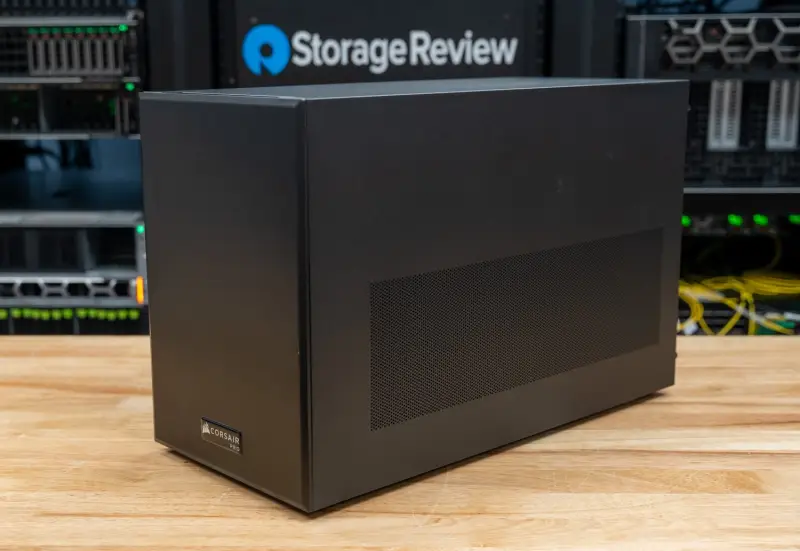
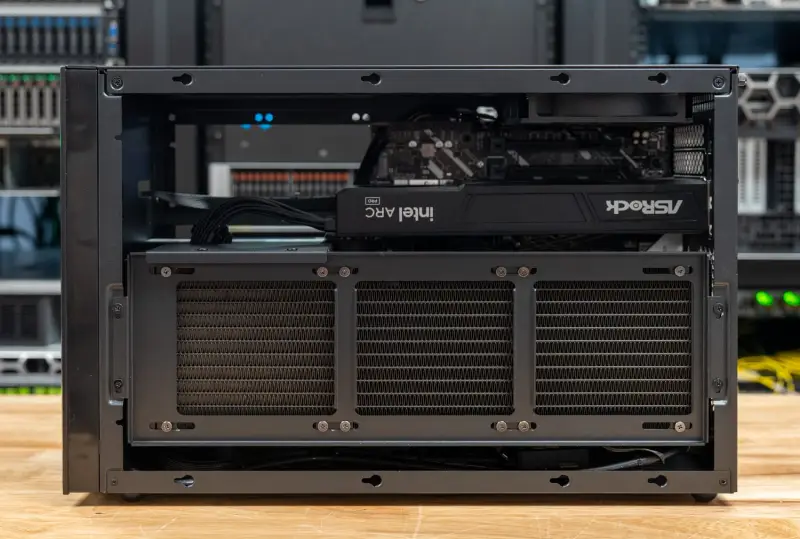
The V20C measures 202 x 451 x 286mm (7.95 x 17.76 x 11.26in) in width, depth and height and weighs 14kg (30.9lb). For a tower that holds a full-size graphics card and a 360mm radiator, that footprint is small. Corsair puts the volume at 26.1 liters.
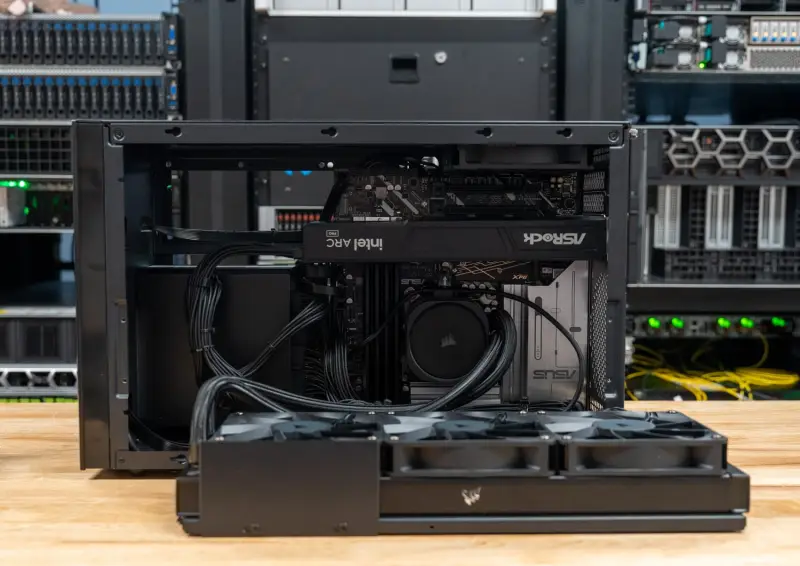
The motherboard is rotated 180 degrees, so the graphics card draws intake air from the top and exhausts out the side. The case clears cards up to 400mm long and has a rear 120mm exhaust mount. The chassis is black, with a Corsair badge on the perforated side panel. We couldn't match the case to a model in Corsair's retail lineup.
Corsair specifies tool-free side panel removal, and the panel on the review unit came off as described. The company calls the layout a component-focused cooling design with individual dedicated airflow paths. The configurator lists support for two 360mm radiators. Corsair also sells a display panel accessory for the side of the chassis. It wasn't tested, and it's hard to see the use case on a workstation.
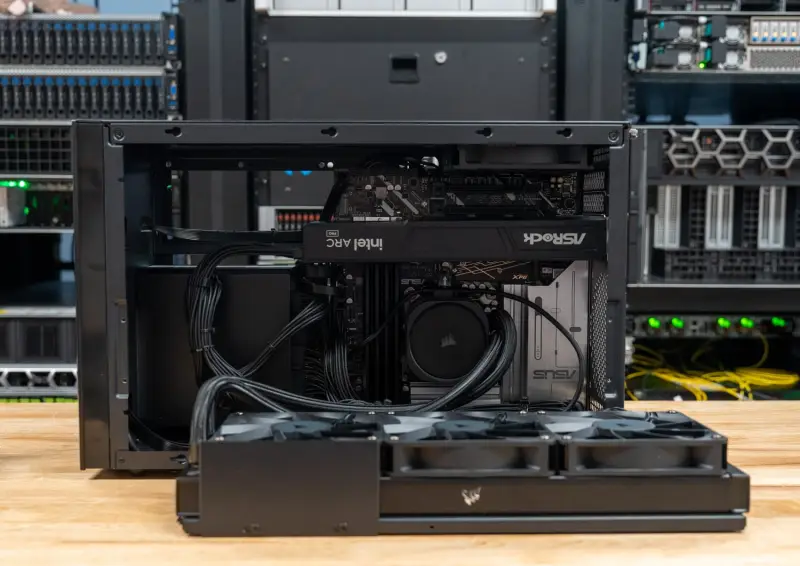
CPU cooling comes from a 360mm liquid cooler, and the chassis carries five 120mm fans. The cooler on the review unit is a variant of Corsair's iCUE LINK TITAN 360 RX RGB, fitted with non-RGB fans. Its radiator and three fans mount on a bracket along the side of the case. The bracket comes away with the tubes still attached, which exposes the motherboard for service. The graphics card is an air-cooled ASRock Arc Pro B70, and power comes from a Corsair RM850e, an 850W unit rated 80 PLUS Gold.
The fans are the one mechanical issue worth flagging. During testing under Ubuntu, they ramped up and down irregularly as loads started and stopped. The lab didn't dig into the cause, so it's unclear whether a setting or firmware change would fix it. If it doesn't resolve, it's a distraction in a room where the machine sits next to a desk, and it's worth checking on a demo unit before buying a fleet.
Board, Memory and Expansion
The motherboard on the review unit is an ASUS PRIME Z890M-PLUS WIFI on BIOS 3012. It's a micro-ATX Z890 board with Wi-Fi 7. Memory is Crucial Pro DDR5-6400 in 16GB DIMMs, with all four slots filled on the test unit. Storage is a 1TB XPG MARS 970 PLUS on a PCIe Gen5 x4 link. These are standard desktop parts, so memory, storage, the graphics card and the power supply can all be replaced later.
Corsair's configurator lists three M.2 2280 slots: one PCIe 5.0 x4 and two PCIe 4.0 x4. Storage expansion also includes six SATA ports, two 2.5-inch bays, and one bay that takes either a 3.5-inch or a 2.5-inch drive. The board has four expansion slots: a PCIe 5.0 x16 slot for the B70, one PCIe 4.0 x4 slot and two PCIe 4.0 x1 slots. With the boot drive in the Gen5 slot, both Gen4 M.2 slots stay free for more storage.
Ports and Connectivity
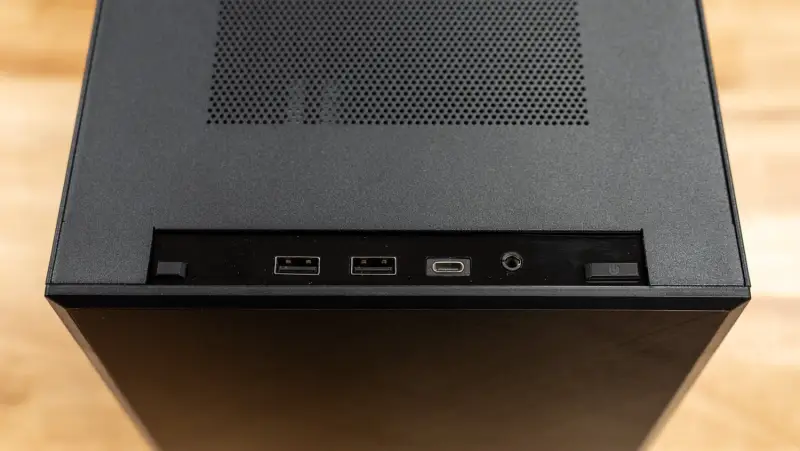
The front I/O strip sits on the top panel. It has one 5Gbps USB Type-C port, two 5Gbps USB Type-A ports and a combo audio jack beside the power button.
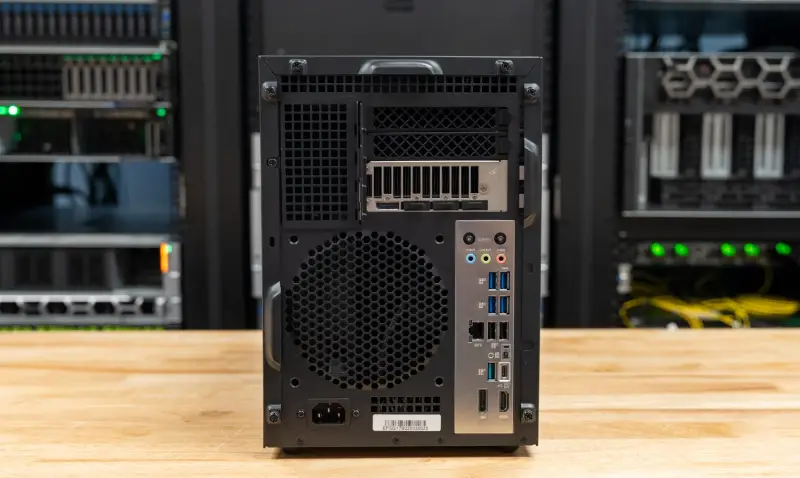
On the rear, the motherboard supplies one 20Gbps USB Type-C port, one 10Gbps USB Type-A port, four 5Gbps USB Type-A ports and two USB 2.0 ports. It also has 2.5GbE, Wi-Fi 7 antenna connectors and three audio jacks. The B70 provides four DisplayPort 2.1 outputs, and the board adds DisplayPort and HDMI for the processor's integrated graphics. That's a lot of display options for a machine that most people will run headless over SSH.
Software, Setup and the Factory Image
Corsair ships the V20C with Ubuntu 24.04 LTS and lists Windows 11 Pro as an alternative in the configurator. The company advertises a turnkey agentic AI software stack with integrated frameworks, GPU acceleration, containers, monitoring and developer tools. A CORSAIR PRO dashboard on that image handles downloading and switching local models, choosing between the PI Agent and Hermes agent harnesses, and managing apps.
Corsair's setup guide for this SKU walks through serving Qwen3.8-27B with llama.cpp in Docker at a 65,536-token context, then connecting Hermes Desktop to that local endpoint. That's a sensible starting point for a developer who wants a working local endpoint on day one.
The configurator describes the Ubuntu installation as including a GPU driver and a compute runtime matched to the graphics card. An optional Corsair AI Stack adds Docker with a GPU runtime, monitoring tools and Python. The lab replaced the factory image before testing, so none of the numbers here depend on Corsair's preinstalled stack. If you're evaluating the box, ask whether you'll be using the factory image or rebuilding it, because the results can shift with the software underneath.
Specifications
| Specification | Corsair FlexPrime V20C |
|---|---|
| SKU | CSW-9040004-NA |
| Processor | Intel Core Ultra 7 270K Plus, 24 cores (8 P-cores, 16 E-cores), 24 threads, up to 5.5GHz |
| Graphics | Intel Arc Pro B70, 32GB GDDR6, 32 Xe2 cores, 256 XMX engines, 608GB/s memory bandwidth, ASRock card as tested |
| Memory | 32GB (2x 16GB) DDR5 as listed; 64GB (4x 16GB) Crucial Pro DDR5-6400 as tested |
| Storage | 1TB M.2 NVMe SSD; XPG MARS 970 PLUS on a PCIe Gen5 x4 link as tested |
| Motherboard | Intel Z890, micro-ATX; ASUS PRIME Z890M-PLUS WIFI as tested |
| Operating System | Ubuntu 24.04 LTS as shipped; Ubuntu 26.04.1 LTS as tested |
| CPU Cooling | 360mm liquid cooler; Corsair iCUE LINK TITAN 360 RX with non-RGB fans as tested |
| System Fans | 5x 120mm |
| GPU Cooling | Air |
| Power Supply | 850W; Corsair RM850e as tested |
| Front Ports | 1x USB Type-C (5Gbps), 2x USB Type-A (5Gbps), 1x combo audio |
| Rear Ports | 1x USB Type-C (20Gbps), 1x USB Type-A (10Gbps), 4x USB Type-A (5Gbps), 2x USB 2.0, DisplayPort, HDMI, 3x audio |
| GPU Outputs | 4x DisplayPort 2.1 |
| Networking | 2.5GbE; Wi-Fi 7, Bluetooth 5.4 |
| Expansion | M.2 2280: 1x PCIe 5.0 x4, 2x PCIe 4.0 x4; PCIe: 1x 5.0 x16, 1x 4.0 x4, 2x 4.0 x1; Bays: 2x 2.5-inch, 1x 3.5-inch or 2.5-inch |
| Dimensions (W x D x H) | 202 x 451 x 286mm (7.95 x 17.76 x 11.26in) |
| Weight | 14kg (30.9lb) |
| Color | Black |
| Warranty | 3 years, lifetime technical support |
| Price | $3,999.99 (Corsair, with 32GB of memory) |
How the Lab Tested It
Corsair's factory image is Ubuntu 24.04 LTS. Because higher-end workstations get tested on Linux with a current kernel, the lab installed Ubuntu 26.04.1 LTS with the 7.0 kernel. That's the same release used on the Dell Pro Max Micro in this comparison. The V20C ran on the performance power profile with BIOS 3012, Mesa 26.0.8 and Intel's xe kernel driver. The suite measured 31.9GB of GPU-usable memory on the Arc Pro B70.
Results come from three in-house suites. The first is sr-client_linux 0.1, the Linux build of the client suite, which covers local AI, content creation, graphics and storage. Cinebench, Geekbench, 3DMark, PCMark and Procyon have no Linux builds, so those tests and the 30-minute sustained loop are absent. The benchmark harness wraps Phoronix Test Suite workloads and y-cruncher. The server suite runs ClickBench, OpenFOAM, STREAM and Valkey.
Client results combine three runs of the suite. Where a test ran more than once, the newest valid result is reported, and each figure is the median of repeated passes. Fine-tuning didn't run on the V20C, because the suite's PyTorch builds target CUDA and ROCm. There's no measured result for the fine-tuning part of Corsair's description. Image and LLM workloads that need 38GB or more of GPU memory didn't fit either.
The comparison set covers three routes to local AI hardware. The Dell Pro Max Micro is a compact workstation with a 24-core Core Ultra 9 285, a 24GB RTX PRO 4000 Blackwell SFF and 96GB of DDR5-6400. The Dell Pro Max with GB10 runs NVIDIA's 20-core GB10 with 128GB of unified memory on NVIDIA's Ubuntu 24.04 image. The AMD Ryzen AI Halo runs a 16-core Ryzen AI Max+ 395 with 128GB of unified LPDDR5X on AMD's Linux developer image.
The Halo ran sr-client_linux 0.1, harness v3.6 and server suite r5.28 on AMD's developer image. The GB10 ran earlier releases of the harness and server suite with the same application versions. The three operating systems ship different compilers, which affects source-built tests such as the kernel compile.
| Configuration | CPU | Memory | GPU | Boot Drive | Operating System |
|---|---|---|---|---|---|
| Corsair FlexPrime V20C | Core Ultra 7 270K Plus, 24 cores | 64GB DDR5-6400 (4x 16GB) | Intel Arc Pro B70, 31.9GB usable | 1TB XPG MARS 970 PLUS, PCIe Gen5 | Ubuntu 26.04.1 LTS, kernel 7.0 |
| Dell Pro Max Micro (FCM2250) | Core Ultra 9 285, 24 cores | 96GB DDR5-6400 (2x 48GB) | NVIDIA RTX PRO 4000 Blackwell SFF, 23.9GB usable | 1TB Sandisk SN8050S, PCIe Gen5 | Ubuntu 26.04.1 LTS, kernel 7.0 |
| Dell Pro Max with GB10 (FCM1253) | NVIDIA GB10, 20 cores | 128GB LPDDR5X-8533, unified | NVIDIA GB10, 121.6GB usable | 4TB PCIe Gen4 | Ubuntu 24.04.5 LTS, NVIDIA kernel 7.0 |
| AMD Ryzen AI Halo | Ryzen AI Max+ 395, 16 cores | 128GB LPDDR5X-8000, unified | Radeon 8060S (integrated), 95.5GB usable | 2TB Micron 4600, PCIe Gen4 link | AMD Linux developer image, kernel 7.2 |
Software paths differ by GPU vendor, and they shape nearly every AI result that follows. On the V20C, MLPerf Client ran through OpenVINO, and llama.cpp ran on its SYCL backend at fp16. Ollama and stable-diffusion.cpp ran through Vulkan, because Ollama's native path placed none of the model on the Arc card. The two NVIDIA systems used CUDA throughout, and the Halo used AMD's ROCm. One Ollama run on the V20C ended with a Vulkan device-lost error and passed on a rerun.
LLM Serving: Where the B70 Earns Its Place
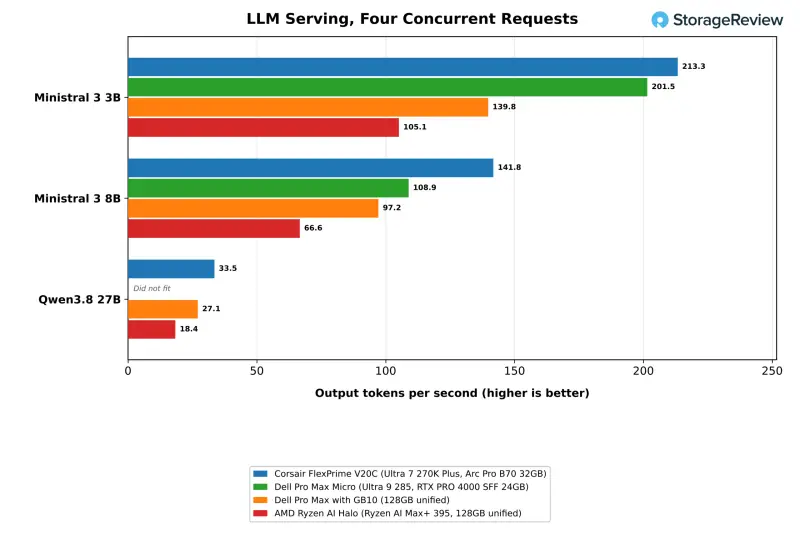
This is the V20C's strongest category. The llama.cpp server ran with 4,096-token prompts and 1,024-token outputs on the Ministral 3 models. The V20C led both NVIDIA systems on those models. It served the 3B model to one user at 84.9 tokens per second, 5 percent ahead of the RTX PRO 4000 SFF and 60 percent ahead of the GB10. On the 8B model it hit 63.7 tokens per second, 22 percent and 72 percent ahead of the same two systems. At four concurrent requests, it delivered 213.3 and 141.8 tokens per second on the 3B and 8B models, 6 and 30 percent ahead of the Dell Pro Max Micro.
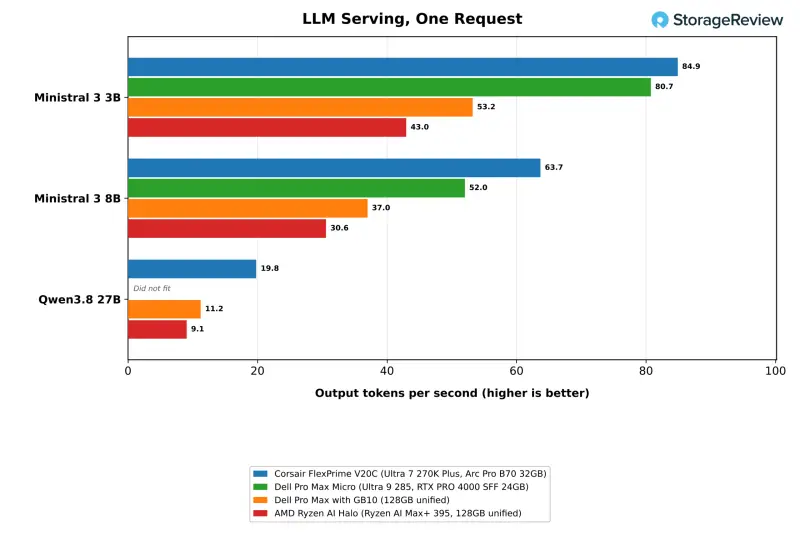
The Halo's integrated Radeon 8060S, running llama.cpp on ROCm, trailed all three. It served the 3B model at 43.0 tokens per second for one request and the 8B model at 30.6, roughly half the V20C's rates on the 8B model. It generated 9.1 tokens per second on Qwen3.8 27B, with a median time to first token of 24.0 seconds against 9.0 seconds on the V20C.
The 27B result is the one to watch. Qwen3.8 27B at Q4_K_M needs 30GB of GPU-usable memory for its weights and one request's KV cache. The 24GB RTX PRO 4000 SFF couldn't run it at all. The V20C's 31.9GB cleared the bar at every concurrency level. With a single request, the V20C generated 19.8 tokens per second, 77 percent faster than the GB10's 11.2. That lead narrowed to 24 percent with four concurrent requests. At eight, the two systems were effectively tied, at 35.4 and 35.6 tokens per second.
Time to first token on the 27B model's 8,192-token prompts was 9.0 seconds on the V20C and 9.2 seconds on the GB10. Prompt processing is roughly level between them, and the B70's advantage shows up in generation. Corsair's figure of about 55 tokens per second for this model doesn't come with its settings. Under the lab's conditions, a single V20C user sees about 20 tokens per second, and total output tops out near 35 as requests are added. That's usable for one developer and tight for a small team sharing the box.
MLPerf Client on OpenVINO
MLPerf Client v2.0 ran through OpenVINO on the Arc Pro B70, and it returned the highest single-stream token rates the V20C produced in any test. Llama 3.1 8B generated 105.4 tokens per second with a first token in 0.08 seconds. Phi-4-mini reached 130.0 tokens per second, with a first token in 0.07 seconds.
The benchmark's Linux release ships only Intel OpenVINO configurations, and it has no arm64 build. None of the other three systems could run it, so the V20C stands alone in this table. That makes it a good signal for Intel-native inference, but it isn't a head-to-head result.
Model Loading and the Coding Agent
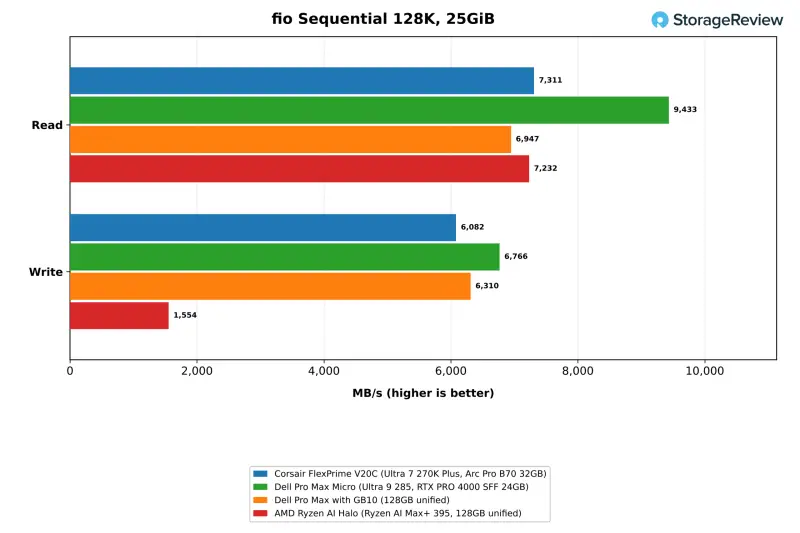
The model-load test times Ollama from launch to first token on gpt-oss:20b, a 12.8GB model. It runs cold from the SSD and warm from the page cache. The V20C took 6.29 seconds cold and 3.18 seconds warm. The Dell Pro Max Micro managed 5.11 and 3.12, the GB10 took 6.86 and 6.36, and the Halo came in at 4.20 and 4.03. During the cold load, the V20C read at 4,040MB/s, against the 7,311MB/s ceiling the lab measured for its drive in fio. The runtime sets the pace more than the SSD does.
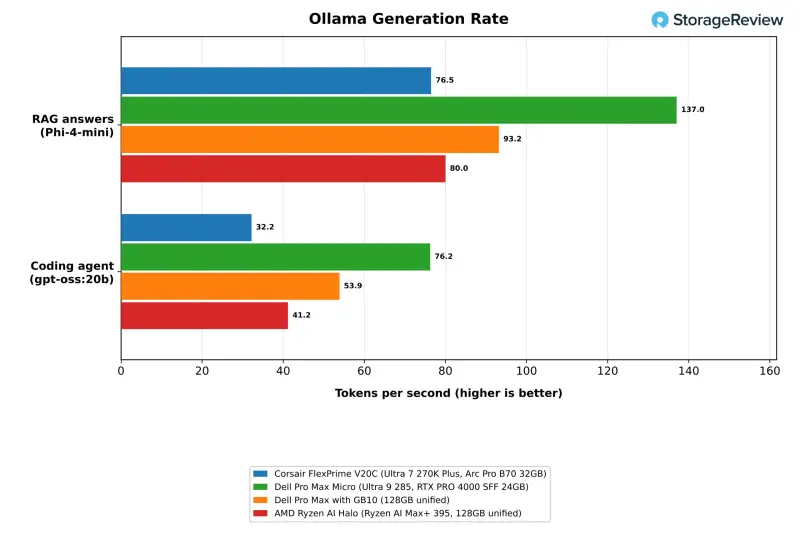
The coding agent test runs Crush against gpt-oss:20b with a 64K context, through a fixed programming task. It ran three times, with up to three rounds each. The V20C passed all three runs with 11 of 11 tests, matching the GB10. The Halo passed two of three, and the Dell Pro Max Micro passed one of three. The V20C's runs took 102, 368 and 530 seconds. Its generation rate of 32.2 tokens per second through Ollama on Vulkan trailed the Halo at 41.2, the GB10 at 53.9 and the RTX PRO 4000 SFF at 76.2.
The 128GB GB10 also ran the agent on qwen3.6:35b-a3b at 64K and 128K contexts. It finished those tasks in a median of 90 and 70 seconds, well under its 221 seconds on gpt-oss:20b. Those tiers didn't run on the V20C. With Speedometer running beside the agent, the V20C's browser score moved from 51.8 to 50.4, a 1.03x slowdown. The Halo's slowdown was 1.16x, and the GB10's was 1.54x under the same test. The V20C's agent workload didn't noticeably punish the browser, which matters for a machine that's also a desktop.
RAG at Two Scales
The smaller RAG test embeds 20,963 SQuAD passages, retrieves the top five for each question and answers with Phi-4-mini, all through Ollama. On Vulkan, the V20C ingested 87.5 passages per second. That's about a third of the Dell Pro Max Micro's 268.2 and well under half of the GB10's 211.4. Answers generated at 76.5 tokens per second, against 137.0 and 93.2. The median time from question to answer was 0.39 seconds, against 0.22 on both NVIDIA systems. The Halo landed closest to the V20C, at 95.5 passages per second on ingest, 80.0 tokens per second on answers and 0.50 seconds from question to answer.
The larger test embeds one million Wikipedia passages through llama.cpp, builds an HNSW index on the CPU and then searches it. With embedding on SYCL, the V20C ingested 321.4 passages per second and finished in 52 minutes, slightly ahead of the Dell Pro Max Micro at 313.9. The same embedding model processed 14,162 tokens per second through Ollama on Vulkan in the smaller test, and 45,498 through llama.cpp on SYCL in this one. The Dell's CUDA rates across the two tests were within 3 percent of each other, so the backend choice is the variable here.
The CPU-side work favors the V20C by a small margin. Its 24 cores built the index in 73.4 seconds against 78.9 on the Dell, and it searched at 29,643 queries per second against 27,359 at an ef setting of 64. Recall against exact search was above 91 percent on both systems. Answer generation returns to Ollama in this test, and the median question-to-answer time was 0.36 seconds on the V20C, against 0.20 on the Dell.
The Halo also completed the million-passage test, but its embedding stage was far slower. It managed 65.8 passages per second and needed 4.2 hours for the ingest. Its 16-core processor built the index in 68.9 seconds and searched it at 34,012 queries per second, ahead of the V20C on both. Its median question-to-answer time was 0.46 seconds.
Image Generation: The Weak Spot
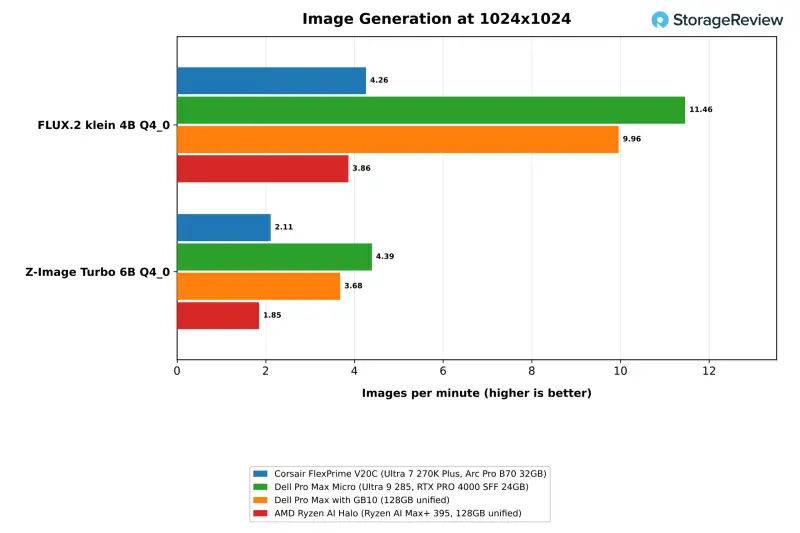
Image generation is the V20C's weakest category. On stable-diffusion.cpp through Vulkan, it produced 4.26 images per minute on FLUX.2 klein 4B at Q4_0. The RTX PRO 4000 SFF managed 11.46 and the GB10 produced 9.96 with CUDA. The GB10 also ran this test on Vulkan and produced 8.29 images per minute, so the backend explains part of the gap. Even so, the B70 ran at about half the GB10's rate on the same API. The Halo produced 3.86 images per minute on ROCm, and it's the one system the V20C led at Q4_0 on this model.
Higher precision widens the difference. At BF16, the V20C fell to 2.40 images per minute on FLUX.2 klein and 0.96 on Z-Image Turbo. Both NVIDIA systems held close to their Q4_0 rates. Memory capacity helps the V20C on Qwen-Image 20B, which needs 28GB at Q4_0. The V20C ran it at 0.35 images per minute, against 0.50 on the GB10 and 0.23 on the Halo, and the 24GB card couldn't load it. The Q8_0 version needs 38GB and ran only on the two unified-memory systems.
CPU and Compute Performance
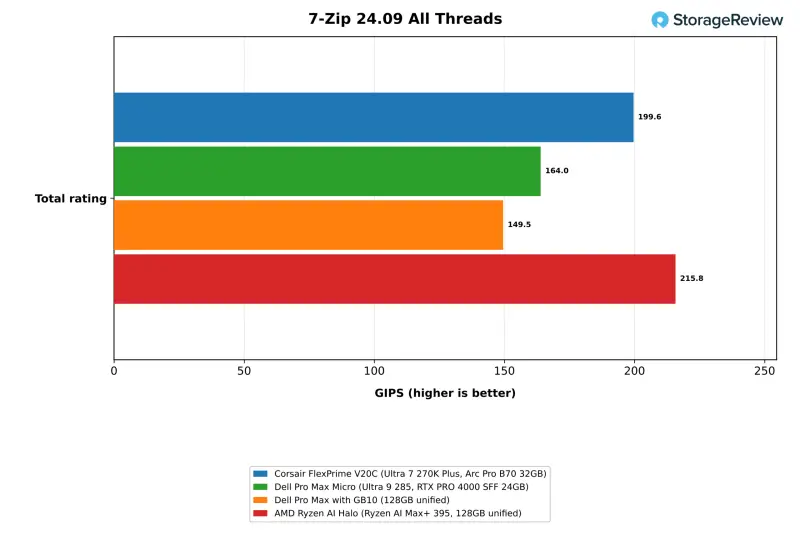
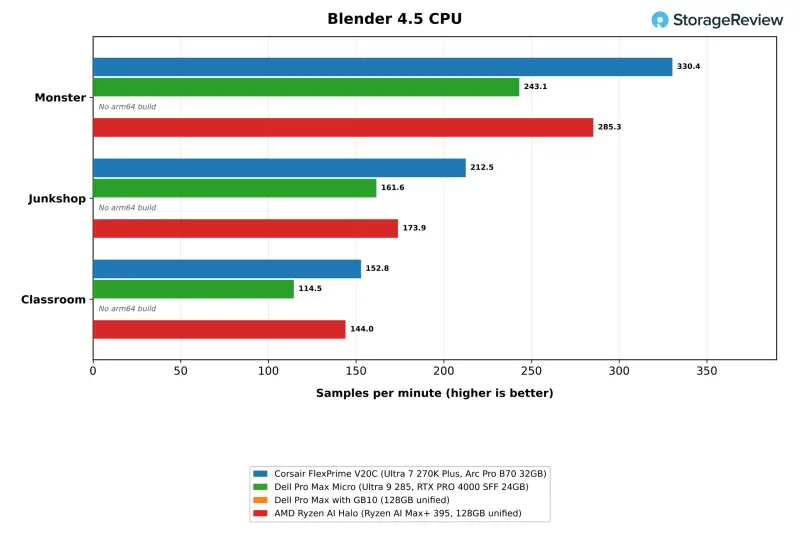
The Core Ultra 7 270K Plus is a 24-core desktop processor under a 360mm liquid cooler, and it led both Dell systems in every row of the 7-Zip, Blender, HandBrake and LLVM table. The V20C scored 199.6 GIPS in all-thread 7-Zip, 22 percent ahead of the Core Ultra 9 285 in the Dell Pro Max Micro and 34 percent ahead of the GB10. Blender ran 31 to 36 percent ahead of the Dell across the three scenes, and its x265 and SVT-AV1 encodes were 25 and 20 percent faster. Blender and HandBrake have no arm64 Linux builds in the suite, so the GB10 has no results there.
The Halo's 16-core Ryzen AI Max+ 395 split these tests with the V20C. It scored 215.8 GIPS in all-thread 7-Zip, 8 percent ahead, and encoded SVT-AV1 at 194.1 fps against 177.4. The V20C led Blender by 6 to 22 percent and x265 by 11.5 percent.
The LLVM build finished in 136 seconds on the V20C, against 173 on the Dell Pro Max Micro and 175 on the GB10. For a developer workstation, that's the most relevant number in the set. Single-thread 7-Zip was closer, with the V20C 3 percent ahead of the Core Ultra 9 285 and 16 percent ahead of the GB10. Both Intel systems have 24 cores, so the multi-thread gap points to the power and cooling headroom of a tower over a compact chassis.
Single-thread and cache-heavy tests tell a similar story. All-thread Stockfish reached 40.55 Mnps on the V20C, 28 percent ahead of the Dell Pro Max Micro and 70 percent ahead of the GB10. primesieve to 10^12 finished in 6.48 seconds, against 8.72 and 9.16. One-thread results between the two Intel systems were within 3 percent in Stockfish and level in primesieve. The V20C scored 51.8 in Speedometer 3.1, against 37.2 on the GB10. Its PyPerformance go result of 56.0ms compares with 85.5ms on the Arm system. The Halo ran close behind in all-thread Stockfish at 38.74 Mnps, finished primesieve in 6.29 seconds and scored 38.7 in Speedometer.
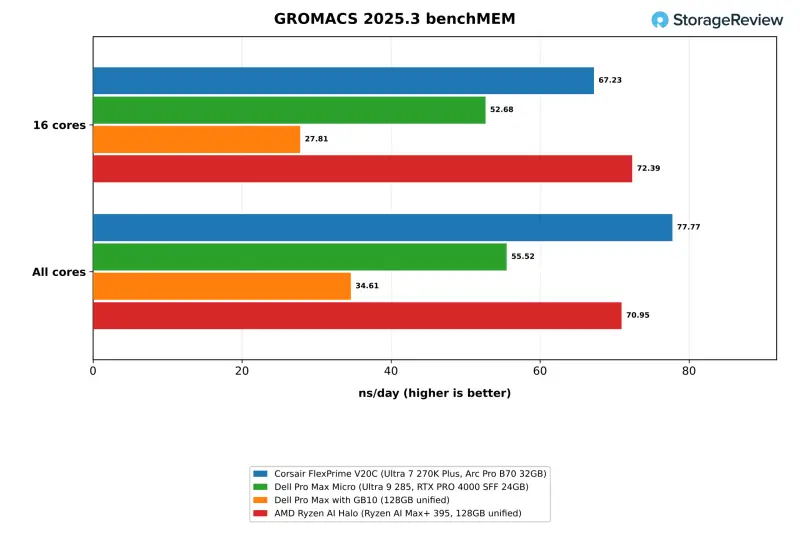
GROMACS benchMEM ran at 67.23 ns/day on 16 cores and 77.77 on all 24. That's 28 and 40 percent ahead of the Dell Pro Max Micro, and more than double the GB10's 27.81 and 34.61. OpenBLAS DGEMM reached 1,100.0 GFLOPS on all cores, against 791.6 on the Dell and 418.0 on the GB10, and the LU solve at N=20000 hit 938.6 GFLOPS. Memory latency on 4KiB pages measured 105.2ns on the V20C's DDR5-6400, the lowest in the group. The Halo led the 16-core GROMACS run at 72.39 ns/day and OpenBLAS DGEMM at 1,610.3 GFLOPS, 8 and 46 percent ahead of the V20C. With every thread in use, the V20C stayed ahead in GROMACS at 77.77 ns/day against 70.95.
Server and HPC Workloads
The server results come from the benchmark harness and server suite, both Linux-only. They treat the V20C as a general compute node: compiling, compressing, serving web and cache requests, running analytics queries and solving a CFD case. Because each system runs a different distribution and compiler, the V20C and the Dell Pro Max Micro, which share Ubuntu 26.04.1, form the tightest pairing.
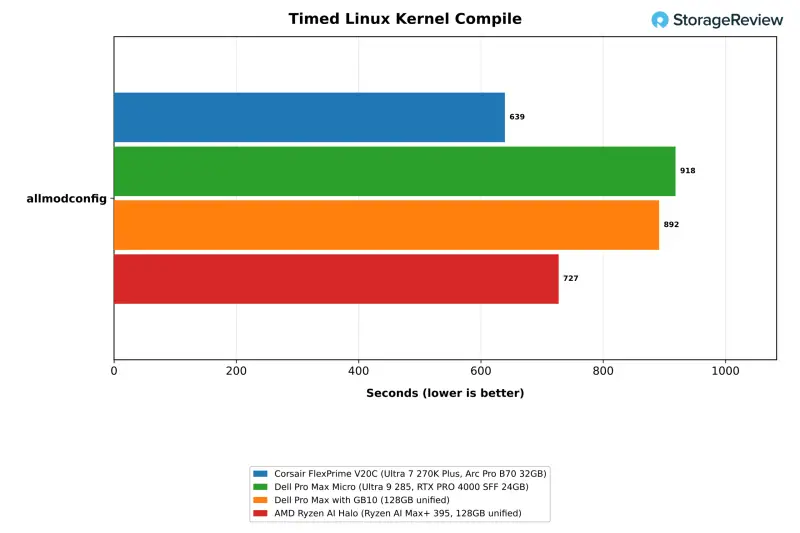
The V20C compiled the Linux kernel in 639 seconds. The Dell Pro Max Micro took 918 and the GB10 took 892. The V20C also led both in 7-Zip, OpenSSL and nginx. The Halo is a closer match than its 16 cores suggest. It compiled the kernel in 727 seconds, tied the V20C in nginx at 1,000 connections and led by 23 percent at 4,000. It ran OpenSSL AES-256-GCM at 298.6GB/s against the V20C's 171.4GB/s. In all-thread 7-Zip it trailed the V20C by 4 percent in compression and led by 11 percent in decompression. The V20C was 28 percent faster in single-thread compression.
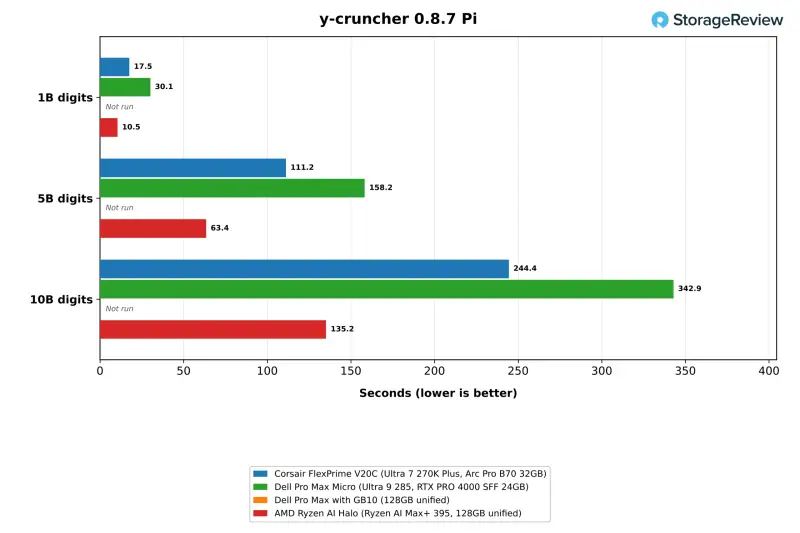
In y-cruncher, the Halo computed five billion digits of Pi in 63.45 seconds, against 111.17 on the V20C and 158.24 on the Dell Pro Max Micro. At ten billion digits the gap widened to 135.18 seconds for the Halo against 244.44 for the V20C. The test is sensitive to memory bandwidth and vector width, and the Halo brings AVX-512 and a wider memory bus, while the V20C has two channels of DDR5. The GB10 hasn't run y-cruncher, so it has no entry in those rows.
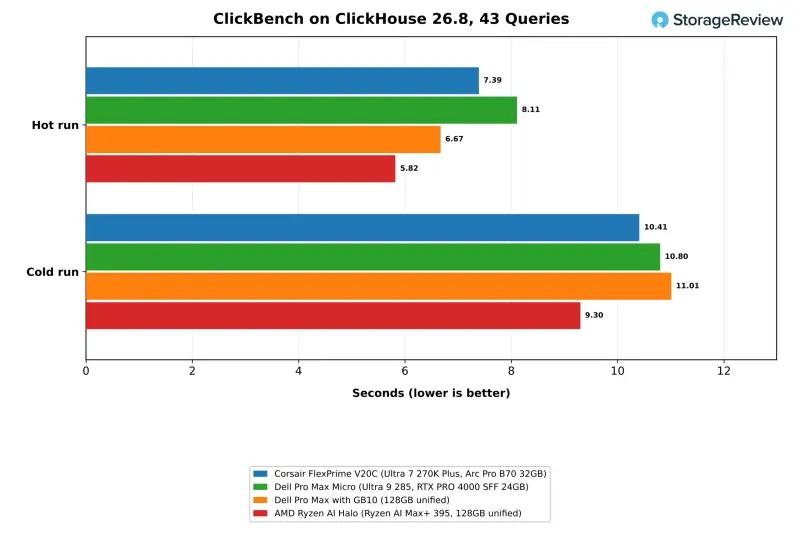
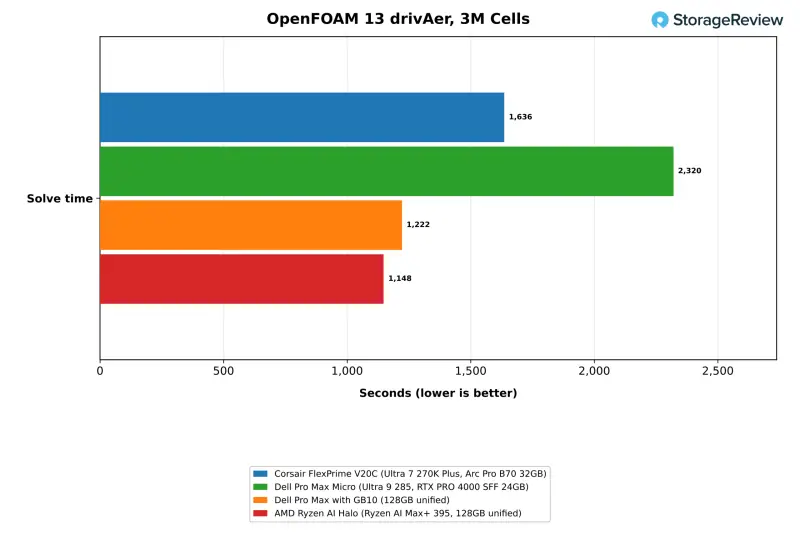
Memory bandwidth explains most of the server suite results. STREAM Triad hit 68GB/s on the V20C's two DDR5 channels, against 121GB/s on the GB10 and 114GB/s on the Halo. The OpenFOAM drivAer case, a 3-million-cell solve, finished in 1,636 seconds on the V20C. The GB10 took 1,222 seconds and the Halo took 1,148. The ClickBench hot run took 7.39 seconds, against 6.67 on the GB10 and 5.82 on the Halo. The Dell Pro Max Micro took 42 percent longer than the V20C in OpenFOAM and 10 percent longer in ClickBench.
The V20C's faster cores gave it the lead in Valkey's cache profile. It handled 1.85 million SET requests and 1.87 million GET requests per second, 33 percent above the Dell Pro Max Micro and more than double the GB10's 810K SET and 885K GET rates. The Halo managed 1.21 million SET and 1.27 million GET, roughly two-thirds of the V20C. A workstation that also hosts a vector store, a cache or a small database next to the model server leans on per-core speed, and the 270K Plus led this group on most per-core tests.
Graphics and GPU Encoding
SuperTuxKart at the highest preset is the suite's one game test. The V20C averaged 345.7 fps at 1080p and 174.0 fps at 4K, on Mesa's OpenGL driver. The GB10 averaged 277.1 fps at 1080p, which puts the Arc Pro B70 25 percent ahead. The test didn't run on the Dell Pro Max Micro. The GB10 has no 4K result because its display was limited to 1080p. The Halo averaged 274.7 fps at 1080p and 90.8 fps at 4K, about half the V20C's 4K rate.
For GPU encoding, FFmpeg 8.1 with HEVC Quick Sync ran at 154 fps on the suite's 4K Big Buck Bunny clip. The VAAPI path ran at 152 fps. The NVIDIA systems use NVENC with different encoder settings, so their 123 and 134 fps results are shown for reference and don't rank the three encoders. The Halo's Radeon ran FFmpeg's VAAPI path at 204 fps. Both Intel encode paths failed to initialize on the first run and worked on the second.
Thermals Under Load
The liquid cooler kept the 270K Plus between 88C and 91C at peak in most all-core tests, with means in the high 70s during Blender, the LLVM build and GROMACS. GROMACS produced the one higher reading, at 97C. The CPU idled at 37C to 38C between tests and averaged 42C to 49C during GPU work such as MLPerf Client, LLM serving and the million-passage RAG run.
The Arc Pro B70 idled near 48C and ran hottest during LLM serving. It peaked at 84C and averaged 80.1C across a 26-minute test. Image generation and the large RAG ingest held it at 82C and 80C. Sustained GPU loads like these are where steady airflow matters most, which makes the irregular fan ramping worth sorting out before the box goes into daily use.
Storage Performance
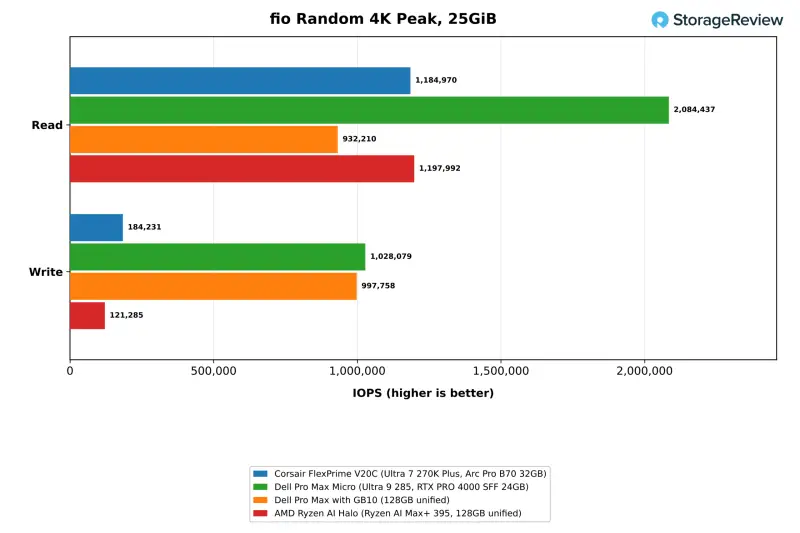
The 1TB XPG MARS 970 PLUS links at PCIe Gen5 x4 but performs like a fast Gen4 drive in sequential work. It read at 7,311MB/s and wrote at 6,082MB/s on the 25GiB footprint. That's close to the Gen4 drive in the GB10, at 6,947 and 6,310MB/s. The Gen5 Sandisk in the Dell Pro Max Micro read at 9,433MB/s. Peak 4K random read reached 1.18 million IOPS on the V20C, ahead of the GB10 and a little over half of the Dell's 2.08 million. The Halo's Micron 4600 read at 7,232MB/s and reached 1.20 million IOPS in random read, level with the V20C.
Random write is the drive's weak point. It peaked at 184K IOPS on the 25GiB footprint and 350K on the 5GiB footprint, with the two passes within 3 percent of each other. The two Dell systems wrote at about 1.0 million IOPS, and the Halo's drive peaked at 121K with a variance flag from the suite. The XPG drive also ran hot, reaching 80.8C with a 75.3C mean across the 99-minute storage test.
Corsair's configurator lists 2TB and 4TB options for the V20 chassis. Buyers who plan to keep datasets or vector indexes on the boot drive should budget for one of those. The drive sits in the M.2 slot between the graphics card and the CPU block, under XPG's heat spreader, with no motherboard heatsink over it.
Where the V20C Lands
The FlexPrime V20C shows the Arc Pro B70 can anchor a capable local AI workstation, provided the software uses the right backend. Through llama.cpp on SYCL, it out-served an RTX PRO 4000 SFF by 5 to 30 percent on the Ministral models. It also ran a 27B model the 24GB card couldn't load, and it beat the GB10 by 77 percent for a single user. Around that GPU, the 24-core 270K Plus led every compile, render and cache-serving test in the comparison.
On price, the V20C lists at $3,999.99 with 32GB of system memory. That puts it level with the AMD Ryzen AI Halo at Micro Center, and about $3,500 below the $7,521 Dell.com lists for a 128GB Pro Max with GB10 and a 1TB SSD. Both of those desktops carry 128GB of unified memory. That lets the GB10 run agent and image models the V20C can't load, and both finished the OpenFOAM case sooner. The V20C's answer is faster llama.cpp serving on models that fit in 32GB, about twice the Halo's rate on the Ministral 8B model, and a tower built from standard desktop parts that are easy to service or replace.
The rough edges are in software and tuning. Ollama and stable-diffusion.cpp fell back to Vulkan and trailed both NVIDIA systems in every generation and ingest test. The fine-tuning test had no Intel path to run on. The fans ramped irregularly, and the 1TB SSD is slow on random writes and peaked at 81C. Developers who serve models through llama.cpp or OpenVINO, and want a strong x86 build machine under the same lid, are the buyers this configuration suits. Teams that depend on Ollama, image generation or models beyond 32GB should look at the unified-memory desktops or one of Corsair's NVIDIA configurations. Before committing, I'd run your own llama.cpp workload on the B70 and confirm the fan behavior, since those two items will decide whether the box earns its place.


