Aina's AI Ring Bets Agents Will Act Before You Ask
Aina's $399 titanium smart ring pairs an OLED display with a context-aware OS that aims to surface AI agent actions before users request them. Shipping is set for January.
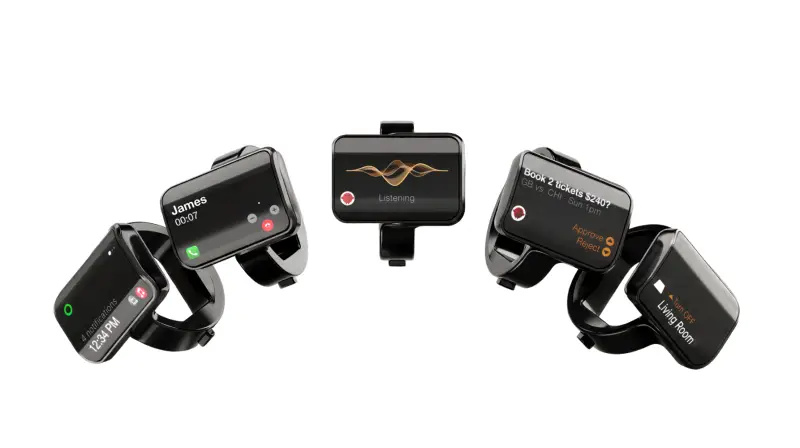
Most AI interactions still start with a small hunt: unlock the phone, find the right app, type or speak a prompt, then wait. Aina Computers Inc. argues that this friction, not model quality, is now the bottleneck. After 15 months in stealth mode, the startup has launched its first product, an AI-native smart ring with an OLED display, designed to control autonomous agents rather than sit beside a phone app.
The problem Aina is targeting
Founder Apoorv Shankar's core claim is that hardware interfaces haven't kept pace with AI software. Models can write code, draft emails and generate images, but accessing them still means opening an app or booting a laptop. Shankar told SiliconANGLE that even routine tasks, like booking a ride, involve opening an app, entering a destination and confirming. Joining a virtual meeting means digging through email for the link.
His framing is that AI is effectively trapped behind a software layer, which limits it to responding when someone asks. That's the gap Aina wants to close: agents that notice context and act first, with the user only approving.
The hardware
The Ring is built from titanium and carries a colourful OLED display, a microphone, a speaker and an 18-hour battery. It also has a mechanical "shifter" that tracks thumb gestures in four directions. The display is the main output surface. Instead of pulling out a phone to read a notification or confirmation, the wearer glances at the ring.
The company's origin matters for understanding the product. Aina began as a human-computer interaction research lab. Its 40-person team tested dozens of hardware concepts, including an adaptive three-key Mac keypad called Dune, before settling on a wearable as the interface for AI agents. Shankar founded the company last year.
The software layer
The Ring runs Aina's Context Aware Operating System, which is designed to learn the wearer's habits over time and anticipate what they'll need. It connects to the user's phone and computer, along with whichever AI agents they already use. Once it's running, the OS tries to predict what information or action is relevant at a given moment and places it on the Ring's display before the user asks.
Shankar's view is that proactive agents are already arriving. He named Muse, Instinct and Dots as agents that will soon handle hundreds of daily tasks, while still waiting for typed or spoken instructions. His expectation is that these agents will learn patterns, build on personal context and start acting on almost every interaction, with the user's approval as the final step.
How people would use it
Input comes in three forms. The microphone handles voice. Pressing and holding the centre button summons an agent to carry out an instruction, and the same control can capture quick voice notes. The Ring can also relay phone calls, so a user can hold it near the ear to talk.
The proactive features are where Aina's pitch gets concrete. Based on time of day, location and schedule, the Ring could offer to order an Uber before the user thinks about it. Confirmation is a click or a spoken "yes." If someone is running late for a meeting, the Ring can draft a message to the other person saying when they'll arrive.
Shankar also described the Ring as a remote control. It can pause or rewind a TV show, adjust microphones and cameras during video calls, and skip tracks when someone is listening to music on an iPod. These are simpler functions, but they show the intended range: one small device covering both agent tasks and everyday device control.
Shankar framed the design around a history of input shifts. "Every major shift in computing has come from software and hardware built together," he said. "The mouse and GUI brought us personal computing. The touchscreen and the app gave us mobile computing. Now with Aina we enter a new era, with personalized computing right at your fingertips."
Price, timing and what's still unproven
The Ring costs $399 and is available for pre-order now. Shipping to customers starts in January. Shankar believes that month will mark a real change in how people work with AI: the interaction becomes mostly a matter of saying yes or no, because the system has already worked out what the user needs.
That claim is the part to test. The source material describes intended behaviour, not measured results. It doesn't include battery figures under proactive use, accuracy of the anticipation engine, or how well the Ring handles agents outside Aina's own ecosystem. Those details will matter far more than the hardware specs once units reach buyers.
What IT teams should be asking
For most administrators, this is a consumer device. Still, a wearable that listens through a microphone, relays calls, connects to phones and laptops, and feeds data to AI agents will end up in offices and on managed devices, whether IT has approved it or not. My read is that the questions to raise early are practical ones. Does the Ring pair with a corporate phone or laptop? Where do the context signals it learns from get stored, and which agents receive them? Can a user keep work calendars, meeting links or email content out of the learning loop? And if a ring starts drafting messages on someone's behalf, who owns that output?
Aina hasn't published answers to those questions in the material available here, so they belong on the checklist before any pilot. The ring itself may be a niche product, but the pattern it represents, agents that act on context from wearables and personal devices, is one that managed-device policies will need to cover sooner or later.


