Circle K and Tesco add fast EV charging across Irish forecourts and car parks
Circle K will add 90 charge points at 11 sites for about €8m, while Tesco and ESB roll out chargers of up to 200kW at selected stores.
Ireland's public EV charging network is about to get noticeably bigger, and most of the new capacity is arriving at two places drivers already visit: petrol forecourts and supermarket car parks. Circle K plans to spend roughly €8m over the next 18 months to add 90 charge points across 11 of its sites. Tesco, meanwhile, is working with ESB to deploy fast and high-powered chargers at selected stores on top of an existing network of 50 sites.

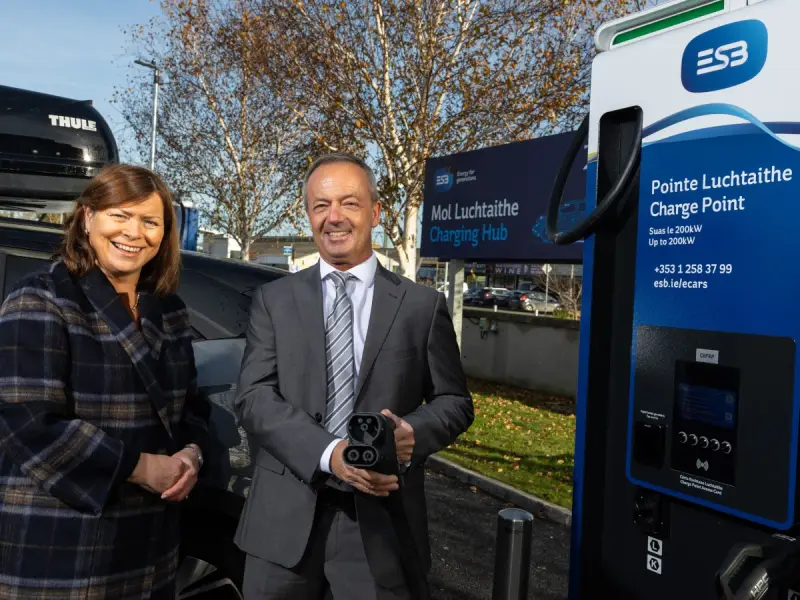
From left: Suzanne Ward, ESB and Darrin Honer, Tesco Ireland. Image: ESB
Circle K's expansion: 90 more points and three large hubs
Circle K already runs 100 of its own-brand EV charge points at 32 sites in Ireland, backed by investments to date of €12m. The new funding will extend that footprint with 90 additional charge points across 11 sites nationwide. The company also plans three large-scale EV hubs, each with between 10 and 20 charging points.
Paul Dixon, managing director of Circle K Ireland, framed the move around customer behaviour. "Helping our customers decarbonise how they travel is a major priority for Circle K," he said. "We are continuing to significantly expand the scale and reach of our network."
Hubs of 10 to 20 points matter because they change the experience. A single pair of chargers at a forecourt serves a top-up. A cluster of that size lets a driver with a flat battery, a fleet van on a tight schedule or a taxi between fares get back on the road without queuing behind one car. That's the model Circle K is betting on, and it's a sensible one for a fuel retailer whose customers already stop for coffee and a few minutes of downtime.
Tesco and ESB: chargers at stores across the country
The Tesco arrangement works differently. Rather than building its own network, Tesco is bringing in ESB, which will deploy chargers of up to 200kW at selected Tesco sites. The first locations named are Clarehall and Clearwater in Dublin, Drogheda and Dundalk in County Louth, and Maynooth in County Kildare. ESB says these chargers will complement its existing charging network rather than compete with it.

ESB's Suzanne Ward, head of emerging markets, linked the rollout to the country's climate targets. "The electrification of transport is central to Ireland's climate goals, and by working together, we're ensuring that drivers have fast and reliable charging options in convenient locations," she said.
Darrin Honer, head of business transformation at Tesco Ireland, put the emphasis on routine. The aim, he said, is to make EV charging "more accessible and convenient for customers as part of their everyday shop." For drivers, that means topping up while the weekly shop gets done, which is a very different proposition from a dedicated charging bay at the edge of a town.

A 200kW ceiling is worth reading carefully. It's the maximum output of the hardware, and what a given car actually takes on depends on its battery chemistry, its state of charge and its own onboard limits. Fleet managers planning routes around a store-based charger should look at real-world session times for their vehicles, not the headline power rating.
Why the timing makes sense
The Society of the Irish Motor Industry reports that new battery electric car registrations in Ireland grew by 55pc in October compared with October 2025. Total new car registrations for the month rose by 15pc over the same period. When the electric share of new sales is rising faster than the market as a whole, charging access becomes the practical question for buyers, and it's the one that retailers can answer quickly.

Transport Minister Darragh O'Brien, who also holds the climate, energy and environment brief, tied the expansion to adoption. "The continued expansion of Ireland's EV charging infrastructure is essential as we support more people to make the transition to electric vehicles," he said. He added that reliable, convenient and fast charging across the country "will be key to supporting the continued uptake of electric vehicles."
The wider European picture points the same way. Research from the European Federation for Transport and Environment, published in July, counted 1.1m public chargers for EVs in the EU by the end of 2025, five times the number in 2020. As of March 2026, every member state except Malta had exceeded its overall charging capacity minimum, based on the number of battery EVs on its roads. Ireland's retail rollouts add to that base at a moment when charging density, not just vehicle supply, is shaping buyer confidence.
What IT and fleet teams should take from this
For most readers of this site, the immediate impact is practical rather than strategic. If your organisation runs electric pool cars, a salary-sacrifice scheme or a growing EV fleet, the arrival of more fast chargers at retail sites changes how you plan trips and whether you need on-site charging at all. Mapping your routes against the named Tesco locations and Circle K's sites is a reasonable first step, and it costs nothing.
There's also a data question worth raising with fleet and facilities colleagues. Public charger locations, session records and payment methods vary by operator, and each network typically has its own app or account system. If you're reconciling charging expenses or tracking energy use for reporting, expect to pull data from several providers rather than one. Build that into your process now, before the number of networks you deal with grows.
Neither company has published a completion timeline beyond Circle K's 18-month investment window, and the Tesco and ESB rollout hasn't given dates for the remaining sites. That gap is the thing to watch. Here's my read: the retailers have found a way to put chargers where people already spend time, and the next useful signal will be how quickly those sites go live and how busy they become once the novelty wears off.
Silicon Republic's reporting on the European research is available for readers who want the wider context: EU countries ahead of targets on public EV charging capacity.


