From Pharmacy Counter to Running a Cell and Gene Therapy Manufacturer
Exmoor Pharma CEO Lucy Foley on how a teenage pharmacy job, UK RNA vaccine work and one-off therapies shape her view of scaling manufacturing.
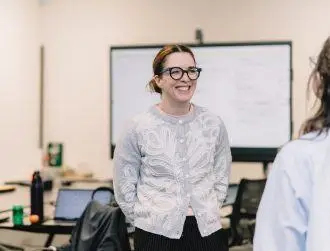
Lucy Foley, CEO of cell and gene therapy manufacturer Exmoor Pharma, didn't follow a single moment into medicine. Her first exposure came early, though. At 13 she was working in a local pharmacy, and during quiet spells the pharmacist explained how medicines worked and how they were dispensed. For a teenager who loved lab work and practical science, that was a formative experience.

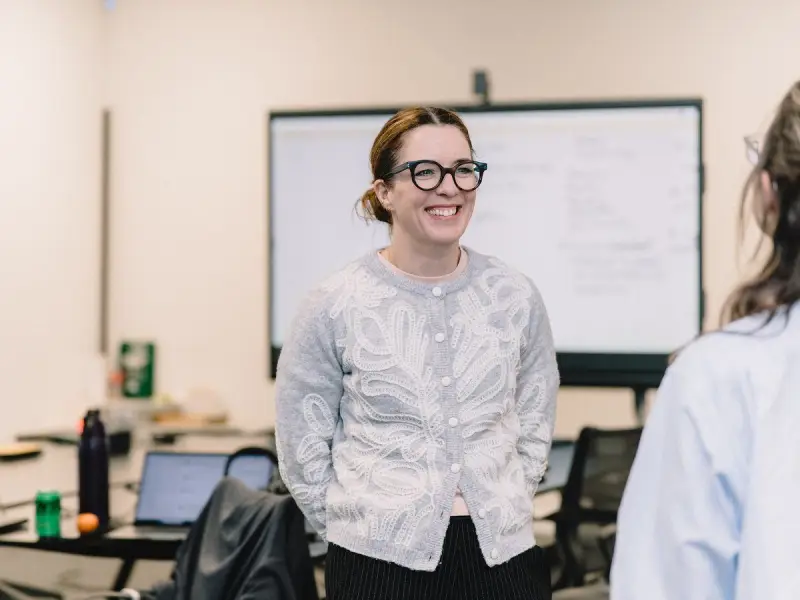
Lucy Foley. Image: Sophie Jordan Photography
Finding a route into engineering
Foley has said that nobody in her family worked in medicine or science, so the pharmacy job showed her that careers in the sector didn't have to mean becoming a doctor. A visit to the college library led her to chemical engineering. Then, while researching degrees, she found biochemical engineering at UCL. For her, that was the turning point. She could study biology, her favourite subject, and still work as an engineer.

That combination matters more than it might sound. Biochemical engineering sits at the point where living systems meet industrial process, and the people who can talk to both scientists and plant operators are rarer than the job market often admits.
Building capacity under pressure
Foley's earlier work covered both biochemical engineering and the business side of it, with a consistent aim: helping novel therapies scale. She was previously part of the UK's CPI, where she helped establish the National Biologics Manufacturing Centre. Later she led the development of the RNA Centre of Excellence during the UK's Covid-19 pandemic response.

She is candid about how that period felt. "I'm not sure I appreciated what we were living through at the time," she said. "It was long days, long nights and constant phone calls. People rang me who I had no idea had got my number, all wanting to discuss whether this could be done in the UK. It was fast and, at times, scary."
She also describes it as one of the most rewarding things she has done. The team believed the work could help with Covid-19 beyond the UK. Even if it didn't, she argues, the country gained infrastructure it had realised it needed, and that should make it more resilient in future.

The experience changed how she thinks about manufacturing. Making the product, she found, was only part of the workload. Vial-filling capacity had to be secured. A storage facility had to hold thousands of RNA vaccine vials at minus 70 degrees Celsius. Distribution had to be arranged, and suitable vaccination centres had to be located. "That was quite mind-blowing to think about," she said. "It reaffirmed for me that manufacturing a drug is only one part of getting it to patients. I look much further along the chain now, at everything else that has to fall into place before a product reaches a patient."
Why one-off treatments raise harder questions
Cell and gene therapy changes the shape of the problem. Many of these treatments take a patient's own cells, modify them and return them to the same person, with the aim of a more targeted treatment or, in some cases, a cure. Each batch is closer to a personalised run than a conventional production line, and that makes scaling difficult.
Foley sees a clear upside in the clinical result. "You treat someone once and the hope is that they stay disease-free for the rest of their life. That changes how we treat illness, and it also raises big questions about how we pay for medicines, particularly in the UK." She argues that funding a one-off treatment with lifetime benefit will shape how medicines are developed, bought and sold. Right now, she says, some processes can treat hundreds of patients, but the field needs to be able to treat thousands.
She also thinks that patients who have received these therapies could be among the next generation of recruits to the industry, which is a point worth taking seriously for any employer trying to fill technical roles.

Automation, AI and the risk-averse factory floor
Foley's view on the path to scale is pragmatic. "Getting there means industrialising how these therapies are made, and automation is desperately needed," she said. She acknowledges that the sector is risk-averse, and that this is appropriate, because the products go into people's bodies.
Her view on digital tools is more pointed. "AI and machine learning are a hugely underused resource for us. We need to open our minds to how they could change the way we manufacture medicines, and I suspect the younger STEM community could teach us a thing or two."
For IT and data teams in regulated manufacturing, that reads as a brief rather than a complaint. Process data, batch records, and equipment telemetry are where any automation or machine learning work would have to start, and that work sits inside validation and quality frameworks that take time to satisfy. Expect the change to come slowly, with pilots that prove quality is maintained before anyone scales them.
Foley's highest priority, though, is access. "That means making these therapies in the best way possible – higher volumes and lower cost of goods – while maintaining quality. If processes can be scaled up or out to serve the markets they need to reach, more patients get treated."
Her message combines a few threads: manufacturing is only part of getting a therapy to a patient, automation and data tools are underused, and cost and volume are what determine who gets treated. For anyone building capacity in this space, the bottleneck she describes is as much about logistics, funding and process design as it is about science. That's the part to watch as the sector moves from small, bespoke batches toward something closer to industrial scale.


