Spryt Takes the Grand Prix and Two Golds at 2026 National Startup Awards
Monaghan health-tech firm Spryt, maker of the Asa AI receptionist, won the Grand Prix and two other golds at the 2026 National Startup Awards in Dublin.
Spryt walked away from the 16th National Startup Awards with three gold results, including the overall Grand Prix and Startup of the Year title. The ceremony took place at Dublin City Hall on 19 November, and the Monaghan company was the only entrant to take gold in both the Tech category and the Export and Global Ambition category. That's a rare double, and it tells you the judges saw the business as more than a good healthcare product.

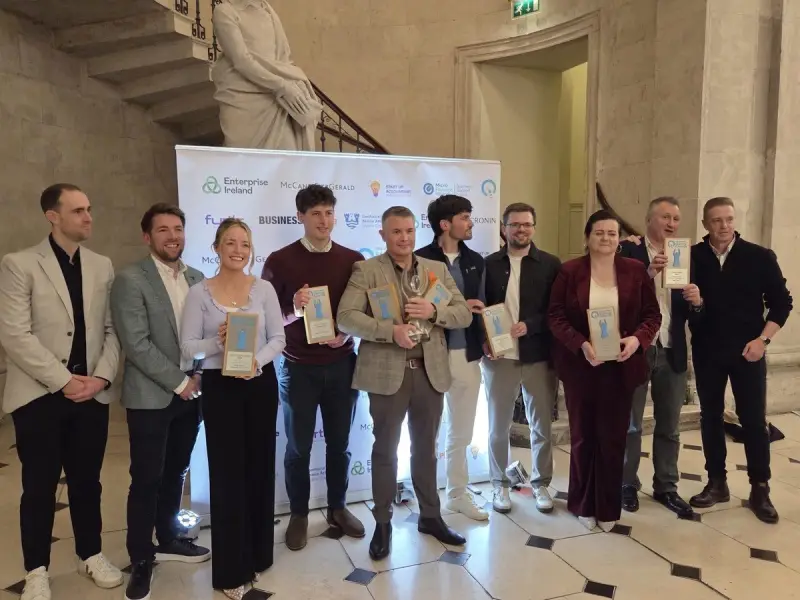
Neill Dunwoody (centre) with category winners at the National Startup Awards in City Hall. Image: Spryt
What the judges rewarded
Spryt is the company behind Asa, an AI receptionist platform aimed at healthcare appointments. Its pitch is straightforward: patients book, change and pay for appointments through messaging apps they already use, such as SMS, WhatsApp and Messenger, and clinics get better visibility over who is likely to miss a slot. The awards put that model in front of a domestic audience, and the Tech and Export results suggest the case for it travels beyond one clinic or one country.

Dunwoody framed the win in terms of access. "We started with a simple belief that technology should make healthcare easier to access, not harder," he said. He also pointed to the company's roots: "To receive this recognition here in Ireland, especially as a company proudly rooted in Monaghan, means a huge amount. We're building something with global ambitions, and this feels like we're only getting started."
Why the no-show problem matters to IT and ops teams
Anyone who has run scheduling for a clinic or a multi-site practice will recognise the problem Spryt is targeting. Missed appointments waste clinician time and leave slots empty, and the fix usually sits in process and reminders rather than in the core clinical system. Dunwoody put the scale in stark terms when he spoke to SiliconRepublic.com about the company's investment earlier this year: "It's a $1trn problem…in the US alone, they [healthcare providers] lose $150bn a year on no shows." Those are his figures, and they haven't been independently verified in the article, so treat them as the company's framing of the market.

His description of the method is more interesting from an operations perspective. Dunwoody said Spryt uses "behavioural science, psychology and linguistics" to push the person who booked to cancel early if they can't attend, so the slot can be refilled. He also said that by working through third-party messaging apps, Spryt avoids asking patients to download an app or create a profile on a system or website. For a practice manager, that reduces one of the biggest friction points in digital booking. For an IT team, it means the integration question shifts toward how the messaging channels and the scheduling back end talk to each other, and who holds the patient data in transit. That's the part I'd want to see documented before any rollout.

Deployments and the numbers behind them
Spryt says it works with the UK's NHS, where Asa has improved attendance by more than 160pc. The company has not published the baseline or the measurement period in the coverage, so that figure is best read as a vendor claim pending a fuller case study. Dunwoody also named Mayo Clinic and Google as organisations the company is working with. Spryt is deploying across US health systems and has pilot programmes underway in Saudi Arabia, the United Arab Emirates and other European markets. One detail stands out: the company does not currently offer its services in Ireland, which makes the domestic award a different kind of signal than a local customer win would be.

The investment that preceded the awards came from MediDrive, a US healthcare transport and logistics company. Dunwoody said the deal valued Spryt at $12.5m. The terms weren't disclosed. At the time, Alan J Murray, president and CEO of MediDrive, said that "Spryt has built one of the most compelling AI platforms in healthcare, redefining how patients connect with care." Read that as MediDrive's view of the product, not an independent assessment.
The company was co-founded by Dunwoody, Paul Lyes, Shaun Dodimead, Nik Kairinos and Daragh Donohoe. Its recent record of recognition is already substantial. Spryt won the overall National Enterprise Award 2025 in Ireland, took a prize at the Healthcare Information and Management Systems Society Europe Startup Pitchfest in 2024, and was named UK MedTech Startup of the Year last year. Taken together, those wins show a company that has been consistently visible in judging rooms across three jurisdictions.
Enterprise Ireland's Conor O'Donovan, Manager of the Startup Unit, put the wider point this way: "Behind every award are years of hard work, risk and persistence from founders and their teams, and it's important that we recognise that." He added that "the ambition on show this year gives us real confidence in the next generation of Irish companies, and Enterprise Ireland looks forward to supporting them as they scale."
The rest of the field
Spryt wasn't the only company with multiple placings. The full winners list, as published, was:
- AI Focused Startup: Gold, Talio; Silver, Locket AI Labs; Bronze, EchoByld
- Sustainable Startup: Gold, Tao Climate; Silver, White Spire; Bronze, ESG Data Core
- Female Founder Startup: Gold, Áine Devlin (ExamRevision); Silver, Siobhain O'Mahony (FemmeBiome); Bronze, Caren Schwannauer (Staq AI)
- Export & Global Ambition Startup: Gold, Spryt; Silver, Zolvia; Bronze, An Even Better Place to Work
- Hospitality & Tourism Startup: Gold, Order IT; Silver, CeolConnect; Bronze, Levels Revenue
- Early Stage Startup: Gold, Octoglo; Silver, Cantivia; Bronze, E-Kiosk Ireland
- Food & Drink Startup: Gold, Hytropics; Silver, Egan's Iced Tea; Bronze, Sip
- Consumer Product Startup: Gold, Aura Sports Cream; Silver, Ealu; Bronze, Ipera
- Tech Startup: Gold, Spryt; Silver, Nexus Inclusion; Bronze, BidReview
- Rising Star: Gold, Bethan Pereira (Cavalloré); Silver, Keith Walsh (ExamRevision); Bronze, Judy Ehiguese (SkynCap)
- Fintech Startup: Gold, Medeblock; Silver, Yes Insurance; Bronze, Slainte Finance
- Medtech Startup: Gold, ArrayPatch; Silver, MedWrite; Bronze, MindPath
The Best Pitch award went to Aisling Mooney of fertility intelligence platform Fertally. For context, the 2025 Grand Prix went to another Irish health-tech start-up, Dublin's Hexis, so health technology has taken the top prize two years running.
What to watch
My read is that the awards confirm Spryt's momentum but don't settle the hard questions. The strongest claims, the 160pc attendance uplift and the no-show economics, are still company figures. If you're evaluating a booking assistant of this type, ask for the measurement method, the baseline period and the data-handling model for messaging channels before you accept the headline numbers. Those are the details that will decide whether a pilot succeeds.
The Irish market is the next test. Spryt's services aren't currently offered here, and a domestic clinical rollout would bring its own integration and governance work. Watch whether the company announces Irish deployments in the coming months, and whether its international pilots move into full contracts. Either would tell you more about the product than another trophy would.


