Altera Agilex 9 Puts FPGA Control Between OQC's Quantum Processor and NVIDIA GPUs
Altera, OQC and NVIDIA have a reference design that puts an Agilex 9 Direct RF FPGA between a quantum processor and GPUs, with release expected in January 2027.
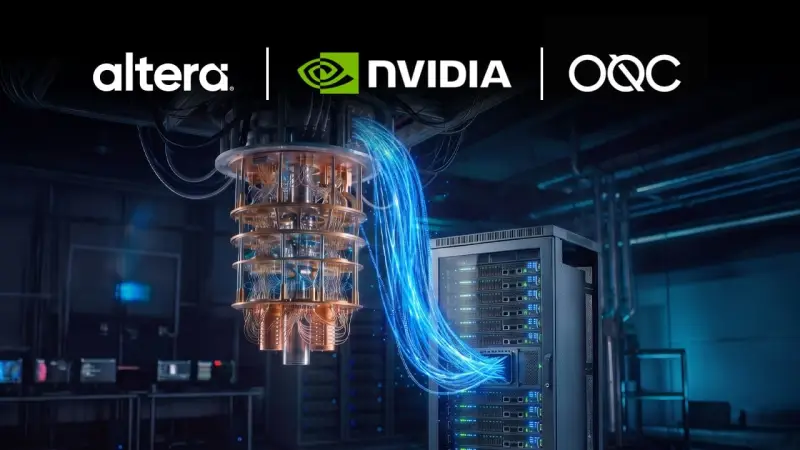
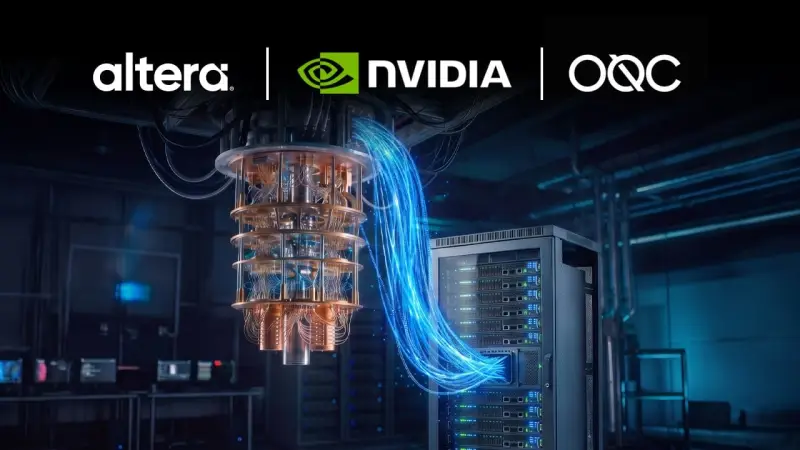
Here's the short version: Altera wants an FPGA to sit at the centre of the quantum control stack, handling real-time qubit control on one side and handing the heavy processing to GPUs on the other. The company has a reference design that shows how. It pairs an Altera Agilex 9 Direct RF FPGA with a new-generation quantum processing unit (QPU) from Oxford Quantum Circuits (OQC), RF conditioning electronics built by OQC, and NVIDIA NVQLink, which connects the FPGA to NVIDIA accelerated computing. Altera expects to release the design in January 2027 and is demonstrating the full system at SC26 in Chicago.
For most IT teams this is still a long way from the data centre floor. But the architecture is worth understanding now, because it shows where quantum systems are heading: a dense, FPGA-driven control layer tied into a conventional GPU cluster over a standardised link.
Why Control Hardware Is the Bottleneck
Altera's argument starts with density. Qubit counts are climbing faster than the physical space available for the classical equipment that controls a quantum processor. Today, that equipment often means racks of discrete RF chains, converters and interconnects, each piece doing one job. Every extra qubit adds more of that hardware, and eventually the control electronics take up more room than the processor they serve.
That's the problem the FPGA is meant to solve. An FPGA can be reconfigured to absorb many of those discrete functions, so the same board can generate pulses, read signals back and schedule operations. Teams in this position typically look for ways to shrink the rack footprint, cut cabling and reduce the number of points where signals have to be converted, and collapsing functions into one programmable device addresses all three.
What the Agilex 9 Brings to the Rack
The Agilex 9 Direct RF FPGA integrates analogue-to-digital and digital-to-analogue converters on the device. In practice that means control and readout can run without an external RF up-conversion or down-conversion stage. Fewer external stages means fewer components to source, calibrate and keep in sync.
Altera lists direct RF sampling at up to 64 GSPS for the Agilex 9 Direct RF-Series. The company hasn't said which specific device the reference design uses, so treat that figure as a family-level spec rather than a confirmed number for this design. Altera also says frequency multiplexing lets several readout channels share a single RF port. That matters as systems scale, because each shared port is one less piece of RF hardware to add per qubit.
Inside the reference design, the FPGA handles real-time qubit control, resonator readout and spectroscopy. Scheduling is synchronised across those functions, which is the kind of deterministic timing that's hard to get from a general-purpose server running the same tasks in software.
GPU Offload Through NVQLink
NVQLink is NVIDIA's open architecture for coupling QPUs to GPU systems. In this design it links the FPGA to GPUs that take on the processing-heavy work, including calibration and machine learning-based readout classification. The split is sensible. Real-time control stays in the FPGA, where latency is predictable, while compute-intensive tasks that can tolerate more time go to GPUs.
The relationship runs both ways. CUDA functions drive the FPGA logic for QPU system functions, so the GPU side isn't just analysing data after the fact. It's shaping how the controller behaves. For anyone who has managed heterogeneous compute, this is a familiar pattern: specialised hardware for the timing-critical path, GPUs for the throughput-heavy work, and a fabric between them that has to be treated as part of the system.
NVQLink isn't limited to this one design. Other quantum hardware builders have already built on it, Quantum Machines among them. That suggests NVQLink is gaining traction as a common interface rather than a one-off integration.
Farhad Shafai, head of business solutions and marketing at Altera, said the demonstration "gives developers a clear path to build on." Simon Phillips, CPO at OQC, described the FPGA as giving the company a programmable, low-latency connection to its QPU. In his framing, control and readout come together in one place, which leaves room to refine calibration and feedback over time.
Software Stack and Emulation
Developers get a validated set of controller functions and a software stack covering qubit and resonator spectroscopy, qubit initialisation, and resonator readout and classification. The package also includes a GPU-based machine learning readout classifier and example GPU-based initialisation functions for the QPU. Sam Stanwyck, director of quantum product at NVIDIA, called it a working reference design for exploring AI-driven calibration and readout.
A built-in emulation path lets teams bring up the controller and test algorithms before physical qubit hardware is available. That's a practical point. Quantum hardware is scarce and expensive, so being able to develop and debug control logic against an emulator shortens the path from design to first experiment. Altera says the approach also helps developers build smaller, lower-power and lower-latency controllers. The company hasn't published latency, power or qubit-count figures for the design, so those claims are worth testing against real hardware when it ships.
The live demonstration is running at Altera booth #2854 at SC26.
What to Watch
My read is that the interesting part here isn't the FPGA on its own. It's the pattern of pairing a reconfigurable, converter-integrated controller with a GPU cluster over a standard link. If that pattern holds, the quantum control rack starts to look less like bespoke laboratory equipment and more like something an infrastructure team can reason about: power budgets, cabling, latency paths and firmware lifecycles.
That said, the open questions are real. The release is still months away, the specific device behind the reference design isn't named, and the performance numbers that matter most for a controller (latency, power and qubit scaling) haven't been published. Before anyone plans around this, they'll want those figures, the full software stack documentation and a clear picture of how the NVQLink integration is supported over time. The January 2027 release date is the next milestone to track, and the SC26 demonstration is the first chance to see the system running.


