Ekco Adds 25 Graduate Places to Cyber and AI Programme for 2027
Irish cybersecurity firm Ekco will take 25 graduates in February 2027 for a programme built around AI-first security skills, automation and data work.

Ekco is putting 25 graduate placements into its cybersecurity and AI programme for 2027, with the intake starting in February. For an MSP that already sells security services, a graduate class of that size is a deliberate bet on where the talent pipeline needs to go, and it says a lot about how the firm sees the next few years of detection and response work.


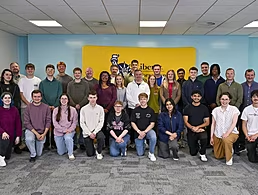
Ekco's Declan Timmons (far left), Aaron Page (back row, second from left) and Cathal Slattery (far right) with graduate hires. Image: Comit PR

What Ekco is actually hiring for
Ekco describes itself as an Irish-owned cybersecurity service provider headquartered in Dublin. The 2027 intake is aimed at graduates who can support the company's AI, automation and data teams, with the stated priority of growing its bench of highly skilled cybersecurity professionals. That mix matters. Ekco isn't only recruiting people to sit in a security operations queue. It's looking for people who will sit between security engineering and the automation tooling that increasingly runs underneath it.

Participants can expect training across security architecture, engineering, penetration testing, threat detection and response, cyber resilience, governance, risk management and compliance. Those areas span the technical and the procedural, which is typical of the way managed security teams now have to work. A graduate who can read a detection rule and also explain why a control matters to a client's risk register is more useful in a live engagement than one who only knows one side of that.

Ekco says graduates from both technical and business-related backgrounds are encouraged to apply. That's a practical signal. Security services increasingly need people who can write up findings, handle client governance conversations and manage compliance evidence, not just break into test environments or tune alerts.

Learning on live customer work
The most concrete detail in the announcement is where the training happens. According to the company, graduates will work alongside more than 400 Ekco security specialists, solving problems for clients in fintech, construction, healthcare, retail, the public sector and critical national infrastructure. Ekco frames that as on-the-job learning, and it's the part of the model that separates a managed security provider's graduate scheme from a classroom course.

Here's the thing: live client work is where judgement develops, and it's also where mistakes cost money. A graduate placed on a real customer problem in a regulated sector gets exposure that a lab environment can't simulate, but the supervision model has to be tight. Teams running similar schemes typically pair new starters with senior practitioners on defined tasks, then widen their scope as they show consistent judgement. Ekco hasn't published details of how its supervision or rotation works, so that's the question to ask if you're evaluating the programme as a benchmark.
Timeline and entry route
Ekco will hold an assessment day at its Dublin headquarters in December, before the programme begins next year. Candidates who are considering the scheme should plan around that date, since the assessment day is the stated gateway before the February start. The company hasn't set out in this announcement how many applicants it expects to see for the 25 places, or what the selection stages look like beyond that day.

Why the AI angle is the real story
Ekco's cyber and AI framing reflects a pattern that IT leaders will recognise. The company's chief messaging point is that attackers are already using AI to move faster, and that defenders need to think in the same way from graduate level. Cathal Slattery, head of security professional services at Ekco, said the company is building "the next generation of AI-first cybersecurity experts," and that graduates who have "grown up with an AI-first approach" are essential to its continued success. Those are the company's claims, and they're worth reading as a statement of strategy rather than as an independent assessment of the threat picture.
Still, the underlying logic holds up for anyone running security operations. If adversary tooling gets faster, the human side of detection and response has to adapt in how analysts are trained, not just in which platforms they log into. Graduates who are comfortable with automation and data pipelines from day one can change how a security team spends its hours, particularly on triage and repetitive investigation work. That's the operational case, and it's the one Ekco is making.

Context from the wider group
The graduate expansion follows a run of acquisitions. Last year, Ekco acquired UK managed services provider Solsoft, Cork's Adapt IT, and Predatech, a UK-based cybersecurity consultancy. Growing through acquisition usually creates a talent problem: the acquired businesses bring their own processes, tooling and staff who need to be folded into one service model. A structured graduate intake gives the group a way to build a common skill base across its sites rather than relying only on hiring experienced people from outside. Whether that works will depend on how well the new starters are integrated across the combined business, which is something the announcement doesn't cover.
What to take from this
For most readers, this isn't a product change or a platform announcement. It's a hiring signal from a provider that sells security services to clients in sectors such as healthcare and critical infrastructure. If you're an MSP owner or IT manager, the practical question is what it does to your own pipeline. Competition for graduates with security and automation skills is likely to tighten as more providers run similar schemes, and the employers that can offer structured supervision on real client work will have an edge in attracting those candidates. Watch for the outcome of the December assessment day and the February intake, since those will show how much of the stated AI-first training makes it into day-to-day client delivery.


